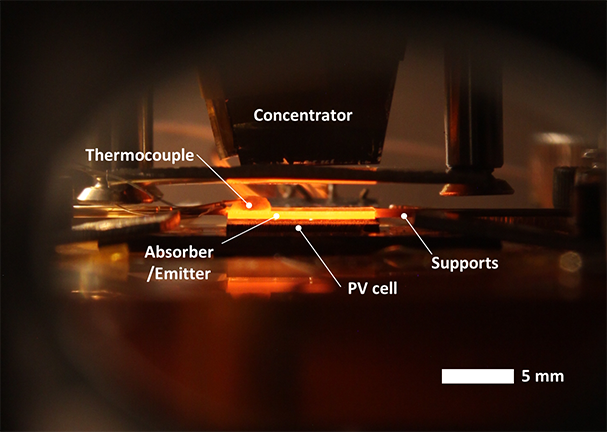

Mechanical engineering graduate student Andrej Lenert and colleagues at MIT recently demonstrated a photonic-crystal based thermophotovoltaic system, which converts heat to electricity. Specifically, they paired a one-dimensional silicon/silicon dioxide photonic crystal emitter with an Indium Gallium Arsenide Antimonide (InGaAsSb) photovoltaic cell to reach thermophotovoltaic efficiency above 5 percent.
The work also predicted through theoretical modeling that solar thermophotovoltaic (STPV) system efficiencies exceeding 10 percent could be achieved using two-dimensional tantalum photonic crystals for the emitter/absorber and a tandem filter with a simple planar layout. Data from the one-dimensional photonic crystal experiments matched predicted results within experimental uncertainty, thus validating the models.
Lenert, 27, presented the research in Washington, D.C., July 18-19, 2013, at a U.S. Department of Energy Frontier Research Centers Principal Investigators meeting.
His former post-doctoral associate Youngsuk Nam presented their paper, a joint effort under MIT Professors Evelyn Wang and Marin Soljacic, at the Transducers Conference in Barcelona, Spain in June.
Read the full article
The work also predicted through theoretical modeling that solar thermophotovoltaic (STPV) system efficiencies exceeding 10 percent could be achieved using two-dimensional tantalum photonic crystals for the emitter/absorber and a tandem filter with a simple planar layout. Data from the one-dimensional photonic crystal experiments matched predicted results within experimental uncertainty, thus validating the models.
Lenert, 27, presented the research in Washington, D.C., July 18-19, 2013, at a U.S. Department of Energy Frontier Research Centers Principal Investigators meeting.
His former post-doctoral associate Youngsuk Nam presented their paper, a joint effort under MIT Professors Evelyn Wang and Marin Soljacic, at the Transducers Conference in Barcelona, Spain in June.
Read the full article