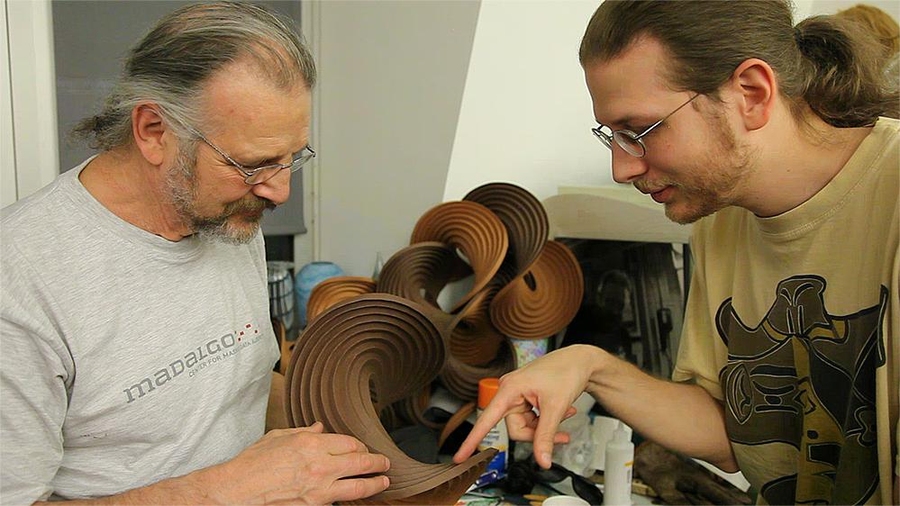
The John Simon Guggenheim Memorial Foundation has announced that Professor Erik Demaine and his father, CSAIL Visiting Scientist Martin Demaine, have been named 2013 Guggenheim Fellows for their work with origami from wood, plastic, metal and glass. The Demaines were selected for this honor from a group of almost 3,000 applicants and are two of the 175 scholars, artists and scientists honored by the Guggenheim Foundation this year.
“These artists and writers, scholars and scientists, represent the best of the best,” said Edward Hirsch, president of the Foundation, about the 2013 class of Guggenheim Fellows. “Since 1925, the Guggenheim Foundation has always bet everything on the individual, and we’re thrilled to continue the tradition with this wonderfully talented and diverse group. It’s an honor to be able to support these individuals to do the work they were meant to do.”
Erik Demaine, a MacArthur Fellow and Alfred P. Sloan Research Fellow, is a member of the Theory of Computation Group and the Algorithms Group at CSAIL. An accomplished artist, his interests include origami and glassblowing. Several of his curved origami sculptures are housed in the permanent collection at the Museum of Modern Art in New York.
Martin Demaine is the Angelika and Barton Weller Artist-in-Residence in the MIT Department of Electrical Engineering and Computer Science, a technical instructor in the Department of Materials Science and Engineering Glass Lab and a member of the Theory of Computation Group at CSAIL.
Since its establishment in 1925, the Foundation has granted over $306 million in fellowships to more than 17,500 individuals, including scores of Nobel laureates, poets laureate, winners of Pulitzer Prizes, Fields Medals and of other important, internationally recognized honors.
“These artists and writers, scholars and scientists, represent the best of the best,” said Edward Hirsch, president of the Foundation, about the 2013 class of Guggenheim Fellows. “Since 1925, the Guggenheim Foundation has always bet everything on the individual, and we’re thrilled to continue the tradition with this wonderfully talented and diverse group. It’s an honor to be able to support these individuals to do the work they were meant to do.”
Erik Demaine, a MacArthur Fellow and Alfred P. Sloan Research Fellow, is a member of the Theory of Computation Group and the Algorithms Group at CSAIL. An accomplished artist, his interests include origami and glassblowing. Several of his curved origami sculptures are housed in the permanent collection at the Museum of Modern Art in New York.
Martin Demaine is the Angelika and Barton Weller Artist-in-Residence in the MIT Department of Electrical Engineering and Computer Science, a technical instructor in the Department of Materials Science and Engineering Glass Lab and a member of the Theory of Computation Group at CSAIL.
Since its establishment in 1925, the Foundation has granted over $306 million in fellowships to more than 17,500 individuals, including scores of Nobel laureates, poets laureate, winners of Pulitzer Prizes, Fields Medals and of other important, internationally recognized honors.