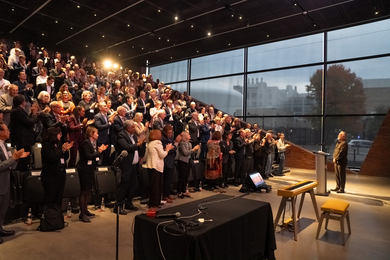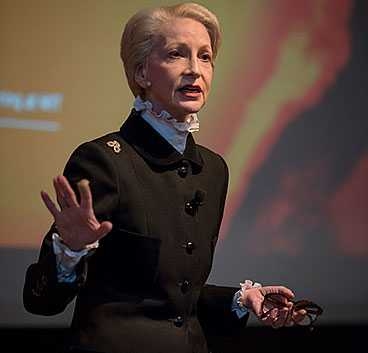
Lady Barbara Judge has a unique global perspective on nuclear power, combining top-level financial and legal experience with oversight and advisory roles in nuclear energy efforts in the United Kingdom, United Arab Emirates, Japan and elsewhere. As MIT NSE’s 12th David J. Rose Lecturer, she shared insights into the many challenges facing nations trying to start or maintain nuclear power programs, while noting that, even in a post-Fukushima world, fission has an essential role in “keeping the lights on for our families, our children, and the two billion people in the world who have no electricity at all.”
Judge, who spent eight years as a director and then chair of the U.K. Atomic Energy Authority and now serves on Tokyo Electric Power Co.’s Nuclear Reform Monitoring Committee, joined a distinguished list of Rose Lecturers, including the I.A.E.A.’s Mohamed El Baradei and Hans Blix, and presidential science advisor John Holdren. The lectures honor nuclear engineering Prof. David J. Rose (1922–1985), a pioneer in controlled fusion as well as technology policy and assessment, and an early leader of interdisciplinary energy studies at MIT.
The need for multi-disciplinary thinking was clear in Judge’s talk, which cited eight separate areas that any country pursuing nuclear energy must address. These ranged from high-level planning and education to economics, waste management and even the psychology of regulatory relationships, which inevitably vary from country to country.
The U.S., Judge said, provides strict “fences” that delineate what is allowable, while the British system tends to emphasize principles. “I think Americans need clear demarcation ... the British are more used to codes of conduct, so it’s horses for courses,” she explained. In pre-Fukushima Japan, she said, regulators and operators tended to be overly close, “so there was no competitive tension, which is what you need — a strong, respected regulator.” Working to remedy this with a more-independent structure is part of Judge’s mission on the TEPCO committee.
But above all, Judge said, “nuclear, first and foremost ... is a political issue. You can’t do anything about building power plants until you get the politics right.”
Read more
Judge, who spent eight years as a director and then chair of the U.K. Atomic Energy Authority and now serves on Tokyo Electric Power Co.’s Nuclear Reform Monitoring Committee, joined a distinguished list of Rose Lecturers, including the I.A.E.A.’s Mohamed El Baradei and Hans Blix, and presidential science advisor John Holdren. The lectures honor nuclear engineering Prof. David J. Rose (1922–1985), a pioneer in controlled fusion as well as technology policy and assessment, and an early leader of interdisciplinary energy studies at MIT.
The need for multi-disciplinary thinking was clear in Judge’s talk, which cited eight separate areas that any country pursuing nuclear energy must address. These ranged from high-level planning and education to economics, waste management and even the psychology of regulatory relationships, which inevitably vary from country to country.
The U.S., Judge said, provides strict “fences” that delineate what is allowable, while the British system tends to emphasize principles. “I think Americans need clear demarcation ... the British are more used to codes of conduct, so it’s horses for courses,” she explained. In pre-Fukushima Japan, she said, regulators and operators tended to be overly close, “so there was no competitive tension, which is what you need — a strong, respected regulator.” Working to remedy this with a more-independent structure is part of Judge’s mission on the TEPCO committee.
But above all, Judge said, “nuclear, first and foremost ... is a political issue. You can’t do anything about building power plants until you get the politics right.”
Read more