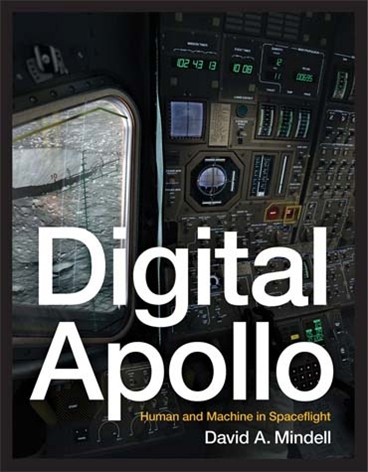
The American Institute of Aeronautics and Astronautics (AIAA) has named MIT historian David A. Mindell the winner of its Gardner-Lasser Aerospace History Literature Award for his book, “Digital Apollo: Human and Machine in Spaceflight.”
“It is wonderful to see David's book receive this important and well-deserved recognition,” says David Kaiser, Germeshausen Professor of the History of Science and head of MIT’s Program in Science, Technology, and Society (STS).
The award recognizes the best original contribution to aeronautical and astronautical nonfiction literature that was published in the last five years and deals with the science, technology and/or the impact of aeronautics or astronautics on society.
“It's a great honor for ‘Digital Apollo’ to be recognized by one's peers in the AIAA,” says Mindell, the Frances and David Dibner Professor of the History of Engineering and Manufacturing and professor of aeronautics and astronautics at MIT. “To my unending delight, this book has really struck a chord with people from all over the world of technology who see how the issues that arose in the Apollo landings were harbingers of those cropping up in today's remote and autonomous systems."
Humans and machines
“Digital Apollo,” which was published by MIT Press in 2011, explores the relationship between humans and computers during the Apollo space program, which launched six manned lunar landings and many other spaceflights between 1963 and 1972. In each of the six landings, the astronaut in command seized control from the computer and landed with his hand on the stick in fly-by-wire mode. Mindell parallels the story of the astronauts' desire to control their spacecraft with the history of the Apollo Guidance Computer, which was designed at MIT.
“As in much of David Mindell's superb historical work, ‘Digital Apollo’ zeroes in on the complicated interplay between humans and machines. He wrests deep meaning from the mundane artifacts of engineering,” Kaiser says. “Blueprints, circuit diagrams and technical reports reveal, in David's skilled hands, a wider world of designers, users and their evolving aspirations.”
Mindell will receive the award on Jan. 8 at a ceremony held in conjunction with the 51st AIAA Aerospace Sciences Meeting in Grapevine, Texas.
Prepared by MIT SHASS Communications
Editorial and Design Director: Emily Hiestand
Senior Writer: Kathryn O'Neill