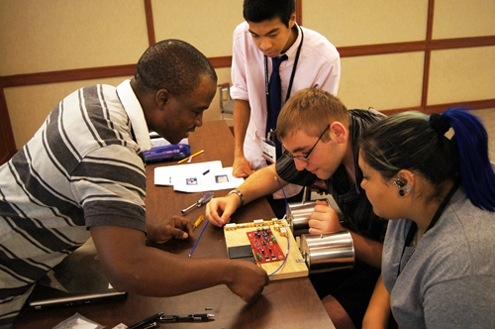

Lincoln Laboratory debuted a new outreach program this July — a summer workshop instructing students how to build small radar systems. The Lincoln Laboratory Radar Introduction for Student Engineers (LLRISE) program focused on radar technology, which is especially fitting due to the Laboratory’s long history and expertise in radar systems.
The project-based enrichment program was developed from a popular three-week class offered during MIT’s Independent Activity Period between semesters and taught by Laboratory technical staff. The course was slightly modified to suit high school students, yet retained the challenging nature of the curriculum.
Juniors from across New England applied for one of 12 openings at this two-week workshop. The hands-on program allowed students to work in a state-of-the-art laboratory, work with highly talented scientists, and live in an MIT dormitory while learning how to build small radar systems. The intent of this program was to impart not only an understanding of radar systems, but also a realization that engineering is about problem solving and applying knowledge in innovative ways.
Students began learning about the basics of radar on the first day after a tour of the Laboratory and the Flight Facility, and started building a small radar as early as the second day of the program.
Interspersed between building and homework were classes integral to radar systems, such as electromagnetics, mechanics of Doppler radar, modular radio frequency design, Matlab, pulse compression, signal processing, and introduction to antennas. The students also received instruction on how to present a project and how to stage experiments.
Read the full story on the Lincoln Laboratory website
The project-based enrichment program was developed from a popular three-week class offered during MIT’s Independent Activity Period between semesters and taught by Laboratory technical staff. The course was slightly modified to suit high school students, yet retained the challenging nature of the curriculum.
Juniors from across New England applied for one of 12 openings at this two-week workshop. The hands-on program allowed students to work in a state-of-the-art laboratory, work with highly talented scientists, and live in an MIT dormitory while learning how to build small radar systems. The intent of this program was to impart not only an understanding of radar systems, but also a realization that engineering is about problem solving and applying knowledge in innovative ways.
Students began learning about the basics of radar on the first day after a tour of the Laboratory and the Flight Facility, and started building a small radar as early as the second day of the program.
Interspersed between building and homework were classes integral to radar systems, such as electromagnetics, mechanics of Doppler radar, modular radio frequency design, Matlab, pulse compression, signal processing, and introduction to antennas. The students also received instruction on how to present a project and how to stage experiments.
Read the full story on the Lincoln Laboratory website