Skip to content ↓

Real-time speech communication on packet networks named an IEEE Milestone

MIT Lincoln Laboratory's role in this seminal R&D effort is honored
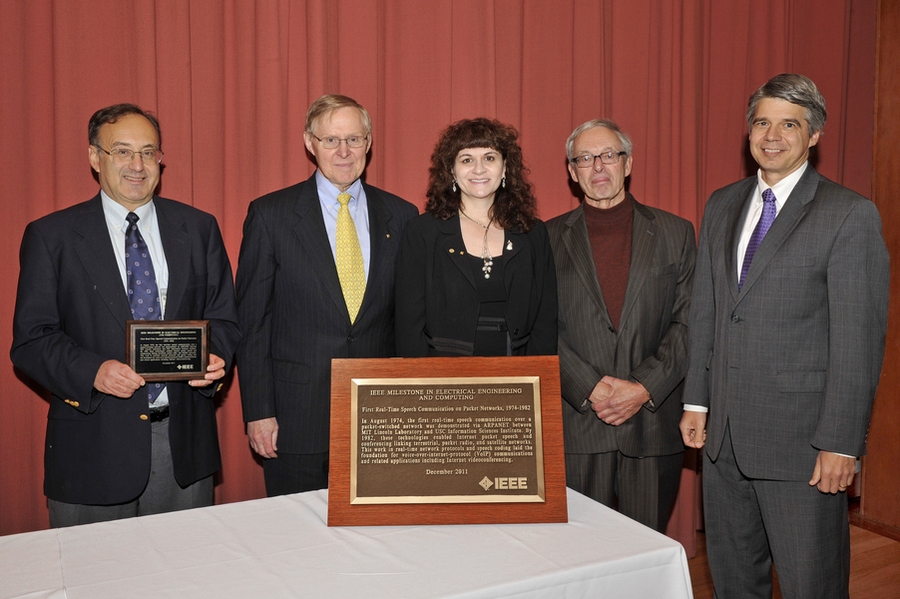
The plaque honoring 'First Real-Time Speech Communication on Packet Networks' as an IEEE Milestone in Electrical Engineering and Computing seen here is installed permanently at Lincoln Laboratory. From left to right are Dr. Clifford Weinstein, a contributor to the milestone achievement and leader of the Human Language Technology Group, Lincoln Laboratory; Dr. Peter Staecker, president-elect, IEEE;...
Caption:
The plaque honoring 'First Real-Time Speech Communication on Packet Networks' as an IEEE Milestone in Electrical Engineering and Computing seen here is installed permanently at Lincoln Laboratory. From left to right are Dr. Clifford Weinstein, a contributor to the milestone achievement and leader of the Human Language Technology Group, Lincoln Laboratory; Dr. Peter Staecker, president-elect, IEEE; Dr. Karen Panetta, chair, Boston Section IEEE; Gilmore Cooke, IEEE Boston Section History and Milestone Committee; and Dr. Eric Evans, director, Lincoln Laboratory.

The IEEE Signal Processing Society and the IEEE Boston Section presented MIT Lincoln Laboratory with an engraved plaque honoring the inclusion of the "First Real-Time Speech Communication on Packet Networks" in the select list of IEEE Milestones in Electrical Engineering and Computing. The plaque that is now permanently installed at the laboratory reads: "This work in real-time network protocols and speech coding laid the foundation for voice-over-Internet-protocol (VoIP) communications and related applications including Internet videoconferencing."

In the 1970s and early 1980s, the laboratory, working on its own and in collaboration with other research laboratories, conducted pioneering research, development and experiments in the use of packet networks for speech communications. For more on these technology developments and the ceremony commemorating this IEEE Milestone, please see the full story.
Related Links

Related Topics

More MIT News

Globular blue and white orbs "examining" single-stranded RNA products and marking them with green checks or red x's

Why are some bacterial genes high in purines?

In certain species of bacteria, the answer lies in shielding RNA transcripts from a quality-control factor called Rho. Understanding the requirements for expressible sequences is critical for expression engineering of therapeutic agents.

Read full story

Rich Nielsen, Volha Charnysh, Kevin Dorst, and Emily Richmond Pollock seated at a table, talking

Building a scholarly community

The SHASS Faculty Fellows Program, administered by the MIT Human Insight Collaborative, is fostering new research projects and creating space for supportive and interdisciplinary discussion.

Read full story