MIT faculty members Ed Boyden and Feng Zhang, along with Karl Deisseroth of Stanford University, have been awarded the Perl/UNC Neuroscience Prize for developing a way to control brain activity using light. The Perl prize carries a $10,000 award and is given annually to recognize a seminal achievement in neuroscience. Four of the 12 past recipients were later awarded Nobel Prizes.
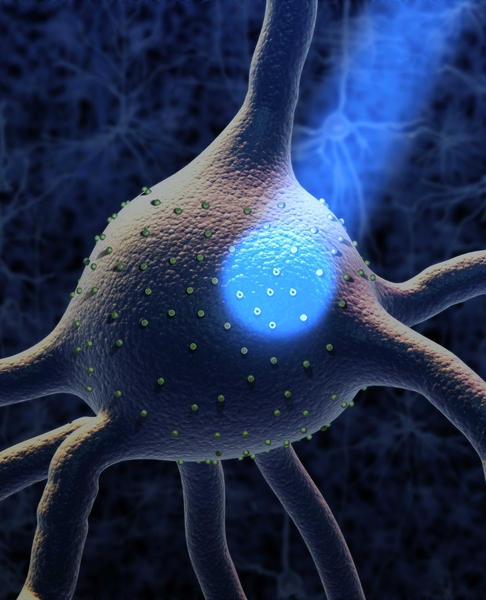
Boyden, Zhang and Deisseroth share the 2012 Perl prize for developing a technology known as "optogenetics," in which neurons are genetically engineered to respond to light. This allows researchers to control the activity of specific cell types with great precision, and to probe the brain’s intricate circuits in ways that would have been unimaginable a few years ago. Optogenetics has already led to major advances in basic neuroscience, and the method has great promise for understanding and potentially for treating a wide range of brain disorders.
Boyden is a faculty member in the MIT Media Lab and an investigator at the McGovern Institute for Brain Research. Zhang is also a McGovern Investigator, with a joint appointment in the Department of Brain and Cognitive Sciences and at the Broad Institute.
Zhang and Boyden will deliver their prize lectures at the University of North Carolina at Chapel Hill on Sept. 20.
Boyden, Zhang and Deisseroth share the 2012 Perl prize for developing a technology known as "optogenetics," in which neurons are genetically engineered to respond to light. This allows researchers to control the activity of specific cell types with great precision, and to probe the brain’s intricate circuits in ways that would have been unimaginable a few years ago. Optogenetics has already led to major advances in basic neuroscience, and the method has great promise for understanding and potentially for treating a wide range of brain disorders.
Boyden is a faculty member in the MIT Media Lab and an investigator at the McGovern Institute for Brain Research. Zhang is also a McGovern Investigator, with a joint appointment in the Department of Brain and Cognitive Sciences and at the Broad Institute.
Zhang and Boyden will deliver their prize lectures at the University of North Carolina at Chapel Hill on Sept. 20.