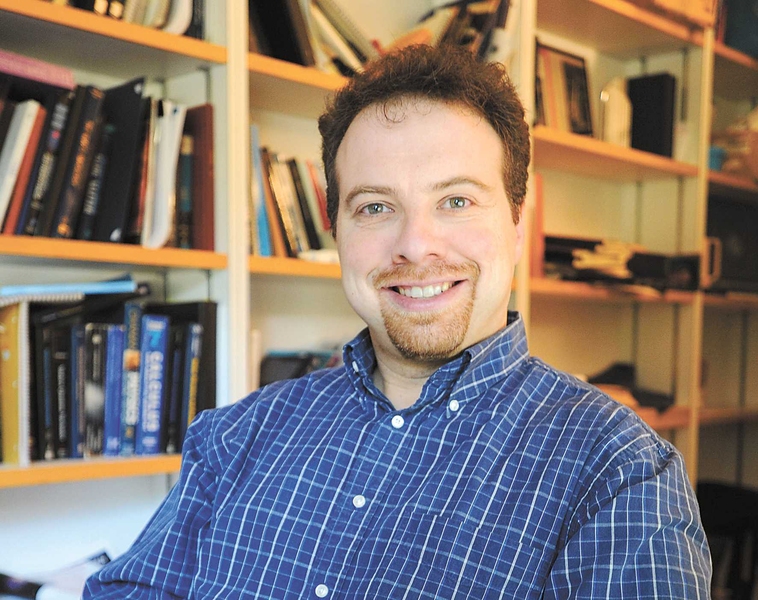
Adam Riess ’92, whose observations of distant supernovae helped reveal that the universe is rapidly expanding, will share the 2011 Nobel Prize in physics, the Nobel Committee announced this morning in Stockholm.
Riess, now a professor of astronomy and physics at Johns Hopkins University, shares the prize with Brian Schmidt and Saul Perlmutter. Perlmutter and Schmidt each headed research teams that in 1998 presented evidence that expansion of the universe was accelerating. Riess was part of Schmidt’s international High-z Supernova Search Team.
For almost a century, the universe had been known to be expanding as a consequence of the Big Bang about 14 billion years ago. However, the discovery that this expansion is accelerating was “astounding,” according to the Nobel committee.
Riess, Perlmutter and Schmidt also shared the $1 million Shaw Prize in Astronomy for discovering the acceleration of the universe’s expansion. Riess, who was born in Washington, D.C., earned his PhD from Harvard in 1996, and was awarded a MacArthur “genius” grant in 2008.
Riess is the 77th MIT-connected winner of the Nobel Prize. See all of MIT's winners at http://web.mit.edu/ir/pop/awards/nobel.html. He will also be on campus on Oct. 20 to deliver the Department of Physics's Pappalardo Distinguished Lecture.
Riess, now a professor of astronomy and physics at Johns Hopkins University, shares the prize with Brian Schmidt and Saul Perlmutter. Perlmutter and Schmidt each headed research teams that in 1998 presented evidence that expansion of the universe was accelerating. Riess was part of Schmidt’s international High-z Supernova Search Team.
For almost a century, the universe had been known to be expanding as a consequence of the Big Bang about 14 billion years ago. However, the discovery that this expansion is accelerating was “astounding,” according to the Nobel committee.
Riess, Perlmutter and Schmidt also shared the $1 million Shaw Prize in Astronomy for discovering the acceleration of the universe’s expansion. Riess, who was born in Washington, D.C., earned his PhD from Harvard in 1996, and was awarded a MacArthur “genius” grant in 2008.
Riess is the 77th MIT-connected winner of the Nobel Prize. See all of MIT's winners at http://web.mit.edu/ir/pop/awards/nobel.html. He will also be on campus on Oct. 20 to deliver the Department of Physics's Pappalardo Distinguished Lecture.