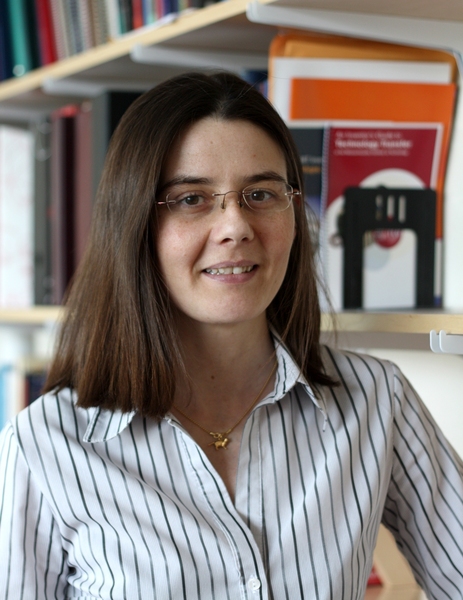
"Quantum engineering" is not yet a household term, but its possible impact on life in the 21st century is enormous. This emerging discipline has the potential to revolutionize computing, precision measurement, materials science and many other fields by harnessing the complex and often-baffling properties of subatomic particles. Moving this technology into reality is the mission of an Department of Nuclear Science and Engineering team led by Assistant Professor Paola Cappellaro.
Unlike mechanics, metallurgy and other ancient engineering practices, quantum engineering grows not from experience, but from theory — specifically, the 20th-century development of quantum mechanics, which seeks to explain the interaction of matter and energy on the atomic and subatomic scale.
Created by titans such as Einstein, Schrödinger and Feynman, this body of knowledge can be deeply counterintuitive, and raises challenging questions about basic mechanisms of the universe. But Paola Cappellaro says she and her team focus on a more practical question as they develop their novel experimental equipment: how can the principles of quantum mechanics be applied to real-world challenges?
Read full article
Over the next few months the Spotlight on Women in Nuclear Science and Engineering series will feature women professors, students and research scientists in the Department of Nuclear Science and Engineering.
Unlike mechanics, metallurgy and other ancient engineering practices, quantum engineering grows not from experience, but from theory — specifically, the 20th-century development of quantum mechanics, which seeks to explain the interaction of matter and energy on the atomic and subatomic scale.
Created by titans such as Einstein, Schrödinger and Feynman, this body of knowledge can be deeply counterintuitive, and raises challenging questions about basic mechanisms of the universe. But Paola Cappellaro says she and her team focus on a more practical question as they develop their novel experimental equipment: how can the principles of quantum mechanics be applied to real-world challenges?
Read full article
Over the next few months the Spotlight on Women in Nuclear Science and Engineering series will feature women professors, students and research scientists in the Department of Nuclear Science and Engineering.