Charles M. Vest, president emeritus at MIT and current president of the National Academy of Engineering (NAE), announced today that three MIT faculty members have been selected to attend the NAE’s 17th U.S. Frontiers of Engineering symposium.
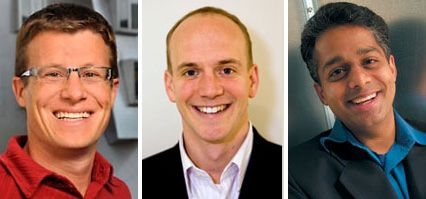
Associate Professors Roman Stocker, of the Department of Civil and Environmental Engineering (CEE); John Ochsendorf, of CEE and the Department of Architecture; and Rahul Sarpeshkar, of the Department of Electrical Engineering and Computer Science and the Research Laboratory of Electronics are among the 85 researchers invited to attend the symposium Sept. 19-21 at Google headquarters in Mountain View, Calif.
Participants are engineers age 30 to 45 who are selected for their exceptional research and technical work from approximately 315 applicants nominated by fellow engineers or organizations.
“The young engineering innovators of today are solving the grand challenges that face us in the coming century,” Vest said. “We are proud that our Frontiers of Engineering program brings this diverse group of people together and gives them an opportunity to share and showcase their work.”
At this year’s symposium, participants will examine additive manufacturing, engineering sustainable buildings, neuroprosthetics and semantic processing. Alfred Z. Spector, vice president of research and special initiatives at Google, will be a featured speaker. Ochsendorf and Sarpeshkar will also make presentations: Ochsendorf on “Challenges and Opportunities for Low-Carbon Buildings” and Sarpeshkar on “Ultra Low Power Biomedical and Bio-inspired Systems."
Read the full news release: http://cee.mit.edu/news/releases/2011/frontiers-of-engineering
Associate Professors Roman Stocker, of the Department of Civil and Environmental Engineering (CEE); John Ochsendorf, of CEE and the Department of Architecture; and Rahul Sarpeshkar, of the Department of Electrical Engineering and Computer Science and the Research Laboratory of Electronics are among the 85 researchers invited to attend the symposium Sept. 19-21 at Google headquarters in Mountain View, Calif.
Participants are engineers age 30 to 45 who are selected for their exceptional research and technical work from approximately 315 applicants nominated by fellow engineers or organizations.
“The young engineering innovators of today are solving the grand challenges that face us in the coming century,” Vest said. “We are proud that our Frontiers of Engineering program brings this diverse group of people together and gives them an opportunity to share and showcase their work.”
At this year’s symposium, participants will examine additive manufacturing, engineering sustainable buildings, neuroprosthetics and semantic processing. Alfred Z. Spector, vice president of research and special initiatives at Google, will be a featured speaker. Ochsendorf and Sarpeshkar will also make presentations: Ochsendorf on “Challenges and Opportunities for Low-Carbon Buildings” and Sarpeshkar on “Ultra Low Power Biomedical and Bio-inspired Systems."
Read the full news release: http://cee.mit.edu/news/releases/2011/frontiers-of-engineering