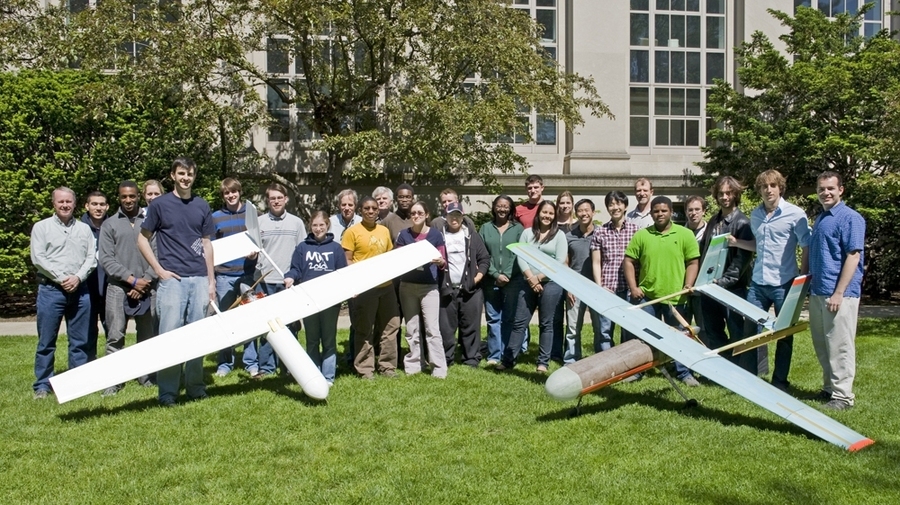
MIT Lincoln Laboratory has a new test asset — an unmanned aerial vehicle, which is the second iteration of a prototype designed and built during the 2009–2010 academic year by 40 students in the Department of Aeronautics and Astronautics.
The aircraft is 6.5 feet long, has a wing span of 10 feet, is made of nonreflective, nonmetallic composites, weighs 48 pounds and can carry a 5-pound payload, and is powered by a two-stroke, two-cylinder 6-horsepower engine. Flight tests showed that the aircraft has the potential to reach a flight ceiling of 15 kft above mean sea level, to achieve a maximum of 80 knots true airspeed, and to fly for three hours without refueling. The tests also confirmed the communications system worked well and the aircraft can successfully hand over to an onboard autopilot.
The aircraft will be used to carry an MIT Lincoln Laboratory payload for measurement of ground-based antenna patterns. In a collaboration with MIT campus, Lincoln Laboratory researchers from the Tactical Defense Systems Group not only provided design guidance and antenna-test-range support but also acted as the "customer" for the aircraft, providing the students with the experience of managing a real-world project. Read more
The aircraft is 6.5 feet long, has a wing span of 10 feet, is made of nonreflective, nonmetallic composites, weighs 48 pounds and can carry a 5-pound payload, and is powered by a two-stroke, two-cylinder 6-horsepower engine. Flight tests showed that the aircraft has the potential to reach a flight ceiling of 15 kft above mean sea level, to achieve a maximum of 80 knots true airspeed, and to fly for three hours without refueling. The tests also confirmed the communications system worked well and the aircraft can successfully hand over to an onboard autopilot.
The aircraft will be used to carry an MIT Lincoln Laboratory payload for measurement of ground-based antenna patterns. In a collaboration with MIT campus, Lincoln Laboratory researchers from the Tactical Defense Systems Group not only provided design guidance and antenna-test-range support but also acted as the "customer" for the aircraft, providing the students with the experience of managing a real-world project. Read more