Skip to content ↓

Special effects leap forward

Members of the MIT community have a history of transforming visual effects; present work is helping to advance green screen technology.
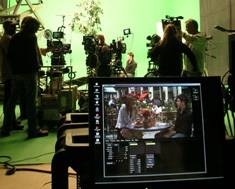
To add backgrounds in post-production, technicians have to know exact camera positions and lens optical parameters used during filming. Currently, visual tracking involves 3,000-pound cranes fitted with rotary measuring devices that lack complete accuracy. Mack's invention puts Intersense optical-inertial and Airtrack inertial sensors onto the camera itself, which precisely record necessary data a...
Caption:
To add backgrounds in post-production, technicians have to know exact camera positions and lens optical parameters used during filming. Currently, visual tracking involves 3,000-pound cranes fitted with rotary measuring devices that lack complete accuracy. Mack's invention puts Intersense optical-inertial and Airtrack inertial sensors onto the camera itself, which precisely record necessary data and eliminate the need to manually figure out tracking info.

Members of the MIT community have a history of transforming visual effects. Herbert Kalmus (1903) and MIT Physics Professor Daniel Comstock co-developed Technicolor (yes, it was named after MIT) in 1915 and Bill Warner ’80 created the Avid digital editing system.

And now Eliot Mack SM ’96 hopes to add his name to the list. His portable Previzion system enables accurate matching of live-action foregrounds and computer-generated backgrounds so directors can see beyond a green screen at how the final shot will look. Watch video of the technology in action.

While green-screen technology is not new (meteorologists swear by it), creating live photorealistic images with it is. Current technology has problems accounting for motion tracking, image resolution, focusing and defocusing background shots, and capturing lens adjustment calibrations, which are crucial for post-production work. Mack has refined his technology to automatically generate camera tracking data and to not miss a single strand of hair against the backdrop. “Essentially, we’re recreating the world on the fly,” he says. So far, it’s been used on the television show V, the upcoming Tim Burton movie Alice in Wonderland, and the Knight Rider made-for-TV movie.

Read the Slice of MIT blog post to learn how Mack's invention works.
 

Press Mentions

The Boston Globe

Herbert Kalmus ‘03 and former MIT Prof. Daniel Frost Comstock ‘04 co-founded Technicolor, the company that helped bring color to the movies. Boston Globe correspondent Scott Kirsner notes that the company’s name was “an homage to MIT, which publishes a yearbook called Technique.” Kirsner adds that Technicolor engineers “had to develop their own cameras, shooting and lighting techniques on set, film processing, and add-ons to the movie projector... Technicolor became one of the giants of 20th-century Hollywood.”

Related Topics

More MIT News

Globular blue and white orbs "examining" single-stranded RNA products and marking them with green checks or red x's

Why are some bacterial genes high in purines?

In certain species of bacteria, the answer lies in shielding RNA transcripts from a quality-control factor called Rho. Understanding the requirements for expressible sequences is critical for expression engineering of therapeutic agents.

Read full story

Rich Nielsen, Volha Charnysh, Kevin Dorst, and Emily Richmond Pollock seated at a table, talking

Building a scholarly community

The SHASS Faculty Fellows Program, administered by the MIT Human Insight Collaborative, is fostering new research projects and creating space for supportive and interdisciplinary discussion.

Read full story