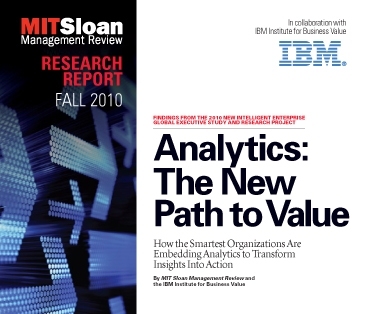
Top-performing companies are three times more likely than their competitors to be leading users of analytics, the science of examining raw data with the aim of making informed decisions, according to a new report released this month by MIT Sloan Management Review. To better understand how organizations are approaching analytics today, the study sampled nearly 3,000 executives and business analysts from 108 countries and 30 industries.
Based on analysis of survey results, the study clearly connects analytics to competitive differentiation and performance. Top-performing firms are five times more likely to apply analytics rather than executives’ intuition across the widest possible range of decisions. And they are two times more likely to shape future business strategies and guide day-to-day operations based on analytics.
“Interestingly, the top performers also turn out to be the organizations most focused on improving their use of analytics and data, despite the fact that they’re already ahead of the adoption curve,” said Michael S. Hopkins, editor-in-chief of MIT Sloan Management Review. “We discovered that the more managers know about analytics-driven management — and see how it can create value — the more they know that they want to know more.”
On Nov. 11 Hopkins hosted a webcast in which a virtual panel of experts discussed the report’s findings. The panel included Erik Brynjolfsson, director of the MIT Center for Digital Business, Stephen Baker, author of The Numerati, and Steve LaValle, global strategy leader for IBM’s Business Analytics and Optimization service line. The report was prepared in collaboration with the IBM Institute for Business Value.
Based on analysis of survey results, the study clearly connects analytics to competitive differentiation and performance. Top-performing firms are five times more likely to apply analytics rather than executives’ intuition across the widest possible range of decisions. And they are two times more likely to shape future business strategies and guide day-to-day operations based on analytics.
“Interestingly, the top performers also turn out to be the organizations most focused on improving their use of analytics and data, despite the fact that they’re already ahead of the adoption curve,” said Michael S. Hopkins, editor-in-chief of MIT Sloan Management Review. “We discovered that the more managers know about analytics-driven management — and see how it can create value — the more they know that they want to know more.”
On Nov. 11 Hopkins hosted a webcast in which a virtual panel of experts discussed the report’s findings. The panel included Erik Brynjolfsson, director of the MIT Center for Digital Business, Stephen Baker, author of The Numerati, and Steve LaValle, global strategy leader for IBM’s Business Analytics and Optimization service line. The report was prepared in collaboration with the IBM Institute for Business Value.