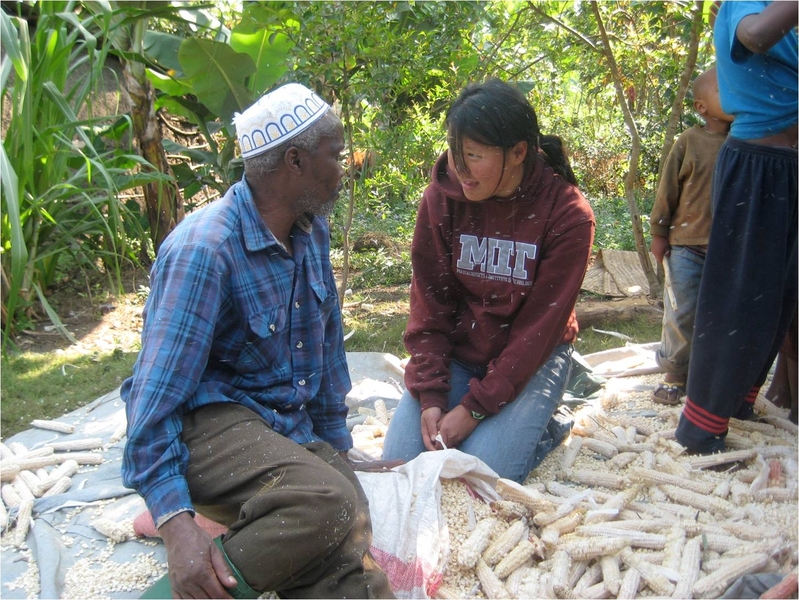
Two MIT alumni have been named among the 16 new recipients of the two-year Echoing Green Fellowship, which offers up to $90,000 in seed funding and technical support to turn innovative ideas into sustainable social change organizations.
2009 graduate Jodie Wu's proposal, “Transforming the Bicycle into a Vehicle for Income-generation and Innovation,” and 2008 graduate Jamie Yang’s proposal, “Offering Poor Households in Tanzania a Battery Subscription Service,” were selected from a pool of more than 1,000 applicants from 73 countries.
Jodie Wu: Global Cycle Solutions
Wu's for-profit social enterprise Global Cycle Solutions (GCS), provides access to technology for the 500 million farmers who own less than 5 acres of land. GCS designs intermediate technology that attaches to bicycles to perform agricultural tasks. The bicycle is mounted on a stand and the attached machine is driven by pedaling; after finishing the work, the machine and stand are removed and the owner can ride the bicycle normally. GCS has developed a maize sheller (corn thresher) and an attachment so people can charge mobile phones as they ride and is developing other machines for rural communities.
While a mechanical engineering major at MIT, Wu participated in Development Lab (D-Lab) classes, the Public Service Fellowship program, and the IDEAS Competition. In 2009, GCS won the MIT $100K Development Track Award and received the Audience Choice Award. Wu currently lives in Tanzania and works full-time for GCS.
Jamie Yang: EGG-energy
Yang’s for-profit social enterprise EGG-energy offers households and small businesses in Tanzania a battery subscription service that provides electricity sufficient to power lights, a radio, and a mobile phone. Customers pay a subscription fee for the portable, rechargeable battery and a small fee to swap it for a fully charged battery. According to EGG-energy, Tanzanians spend more than 10 percent of their income on kerosene or disposable batteries, yet 80 percent of Tanzanians live within 5 kilometers of the energy grid. EGG-energy seeks to solve the distribution problem and offer customers comprehensive electricity services at a lower cost than what they are currently spending. In 2009, EGG-energy was a 2009 IDEAS Competition award-winning team.
2009 graduate Jodie Wu's proposal, “Transforming the Bicycle into a Vehicle for Income-generation and Innovation,” and 2008 graduate Jamie Yang’s proposal, “Offering Poor Households in Tanzania a Battery Subscription Service,” were selected from a pool of more than 1,000 applicants from 73 countries.
Jodie Wu: Global Cycle Solutions
Wu's for-profit social enterprise Global Cycle Solutions (GCS), provides access to technology for the 500 million farmers who own less than 5 acres of land. GCS designs intermediate technology that attaches to bicycles to perform agricultural tasks. The bicycle is mounted on a stand and the attached machine is driven by pedaling; after finishing the work, the machine and stand are removed and the owner can ride the bicycle normally. GCS has developed a maize sheller (corn thresher) and an attachment so people can charge mobile phones as they ride and is developing other machines for rural communities.
While a mechanical engineering major at MIT, Wu participated in Development Lab (D-Lab) classes, the Public Service Fellowship program, and the IDEAS Competition. In 2009, GCS won the MIT $100K Development Track Award and received the Audience Choice Award. Wu currently lives in Tanzania and works full-time for GCS.
Jamie Yang: EGG-energy
Yang’s for-profit social enterprise EGG-energy offers households and small businesses in Tanzania a battery subscription service that provides electricity sufficient to power lights, a radio, and a mobile phone. Customers pay a subscription fee for the portable, rechargeable battery and a small fee to swap it for a fully charged battery. According to EGG-energy, Tanzanians spend more than 10 percent of their income on kerosene or disposable batteries, yet 80 percent of Tanzanians live within 5 kilometers of the energy grid. EGG-energy seeks to solve the distribution problem and offer customers comprehensive electricity services at a lower cost than what they are currently spending. In 2009, EGG-energy was a 2009 IDEAS Competition award-winning team.