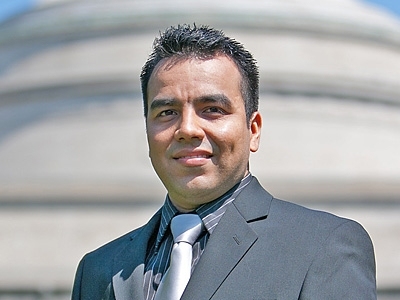
The gap between aeronautics and computer science is narrower than you'd think, and Postdoctoral Associate Rick Cory is proof. Though his background is in computer science and robotics, that didn't stop him from receiving a high honor in the field of aviation. At the Farnborough Airshow in Hampshire, England, yesterday, Cory was named the 2010 Boeing Engineering Student of the Year.
A member of the Computer Science and Artificial Intelligence Lab's Robot Locomotion Group, Cory received the award for his work on developing a perching airplane alongside Associate Professor Russ Tedrake. Together, they developed a glider with the ability to land on a wire like a bird.
Before beginning work on the perching-glider project in 2005, neither Tedrake nor Cory had a background in aeronautics. "We were trying to think of a project that could push the limits of robot control, and the idea came up of trying to build a robot that could fly like a bird," Cory recalls. "For me that was a very inspiring, fantastic idea. From that point on it was literally a matter of picking up Aerodynamics 101 books and learning as much as I could."
Tedrake and Cory drew inspiration from nature, studying the patterns and trajectories of avian flight. They found a compelling challenge in building a vehicle that, like a bird, could take advantage of available drag in order to land on a fixed target. The current iteration is a foam glider with a single motor and minimalistic control system. The design could have far-reaching applications in the development of small, highly maneuverable unmanned air vehicles.
For Cory, who will leave MIT next month to build next-generation robots for Walt Disney Imagineering, receiving the Boeing award is highly validating. "It's certainly humbling to get recognition from one of the most recognized names in aviation," Cory says. "[Russ and I] are both computer scientists, and I would be lying if I said there weren't points when we wondered if anyone was going to think that this work was important. So seeing the excitement that people have about the project is amazing."
A member of the Computer Science and Artificial Intelligence Lab's Robot Locomotion Group, Cory received the award for his work on developing a perching airplane alongside Associate Professor Russ Tedrake. Together, they developed a glider with the ability to land on a wire like a bird.
Before beginning work on the perching-glider project in 2005, neither Tedrake nor Cory had a background in aeronautics. "We were trying to think of a project that could push the limits of robot control, and the idea came up of trying to build a robot that could fly like a bird," Cory recalls. "For me that was a very inspiring, fantastic idea. From that point on it was literally a matter of picking up Aerodynamics 101 books and learning as much as I could."
Tedrake and Cory drew inspiration from nature, studying the patterns and trajectories of avian flight. They found a compelling challenge in building a vehicle that, like a bird, could take advantage of available drag in order to land on a fixed target. The current iteration is a foam glider with a single motor and minimalistic control system. The design could have far-reaching applications in the development of small, highly maneuverable unmanned air vehicles.
For Cory, who will leave MIT next month to build next-generation robots for Walt Disney Imagineering, receiving the Boeing award is highly validating. "It's certainly humbling to get recognition from one of the most recognized names in aviation," Cory says. "[Russ and I] are both computer scientists, and I would be lying if I said there weren't points when we wondered if anyone was going to think that this work was important. So seeing the excitement that people have about the project is amazing."