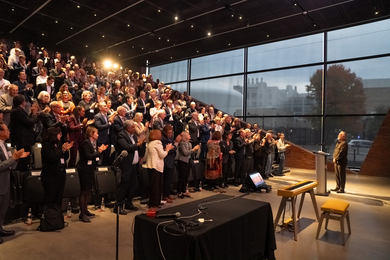
The National Academy of Sciences (NAS) awarded Professor Sallie W. (Penny) Chisholm the Alexander Agassiz Medal for original contribution in the science of oceanography at a ceremony in Washington, D.C., April 25.
Chisholm, the Lee and Geraldine Martin Professor of Environmental Studies in the Department of Civil and Environmental Engineering and the Department of Biology, was chosen for her “pioneering studies of the dominant photosynthetic organisms in the sea and for integrating her results into a new understanding of the global ocean.”
She was a member of the team of scientists from the Woods Hole Oceanographic Institution and Harvard that in 1986 discovered Prochlorococcus, a photosynthetic marine microbe that Chisholm has since developed into a model organism that can be studied from the molecular to the global level. Thanks to the research of Chisholm and others, we now know that these are the smallest and most abundant photosynthetic cells in the oceans, often accounting for as much as half of the oxygen production in some regions of the sea.
In announcing its selection, the NAS award committee said: “Dr. Chisholm is an outstanding biological oceanographer whose studies have revolutionized our views of photosynthesis in the ocean. In particular, her use of flow cytometry (a technique for electronically counting and examining microscopic particles in a stream of fluid) has led her and her colleagues to the discovery that small plankton (in particular Prochlorococcus) account for a much more substantial part of marine productivity than had previously been realized."
Read more
Chisholm, the Lee and Geraldine Martin Professor of Environmental Studies in the Department of Civil and Environmental Engineering and the Department of Biology, was chosen for her “pioneering studies of the dominant photosynthetic organisms in the sea and for integrating her results into a new understanding of the global ocean.”
She was a member of the team of scientists from the Woods Hole Oceanographic Institution and Harvard that in 1986 discovered Prochlorococcus, a photosynthetic marine microbe that Chisholm has since developed into a model organism that can be studied from the molecular to the global level. Thanks to the research of Chisholm and others, we now know that these are the smallest and most abundant photosynthetic cells in the oceans, often accounting for as much as half of the oxygen production in some regions of the sea.
In announcing its selection, the NAS award committee said: “Dr. Chisholm is an outstanding biological oceanographer whose studies have revolutionized our views of photosynthesis in the ocean. In particular, her use of flow cytometry (a technique for electronically counting and examining microscopic particles in a stream of fluid) has led her and her colleagues to the discovery that small plankton (in particular Prochlorococcus) account for a much more substantial part of marine productivity than had previously been realized."
Read more