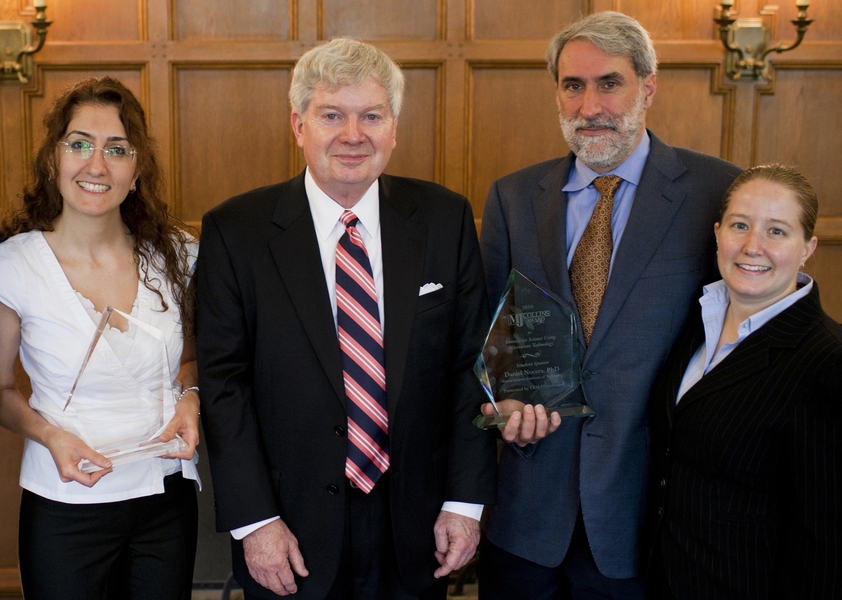
Dilek K. Doğutan, a second-year postdoctoral associate in the Department of Chemistry, has won the 2010 MJ Collins Award for Innovative Scientific Research Using Microwave Technology, which is presented by CEM Corporation, a global provider of microwave laboratory instrumentation. Doğutan and her academic sponsor, Daniel G. Nocera, the Henry Dreyfus Professor of Energy and professor of chemistry, will share a $10,000 prize.
Michael J. Collins, president and CEO of CEM Corporation, presented the researchers with their award on Friday, Sept. 24, at MIT.
“[Doğutan] exemplifies the scientific ingenuity and innovation that is going to be needed to move beyond the current dependence on traditional energy sources and into a new era of clean, renewable energy,” Collins said.
Doğutan’s research focused on the design and synthesis of novel catalysts for solar energy storage and release that will contribute significantly to the development of a personalized solar-energy system — which has been a central part of Nocera’s research. Nocera’s group has been dedicated to producing catalysts that can take solar energy and convert it into stored fuels with a focus on artificial photosynthesis.
MIT has patented her discoveries and licensed them to Italian energy company Eni S.p.A.
Michael J. Collins, president and CEO of CEM Corporation, presented the researchers with their award on Friday, Sept. 24, at MIT.
“[Doğutan] exemplifies the scientific ingenuity and innovation that is going to be needed to move beyond the current dependence on traditional energy sources and into a new era of clean, renewable energy,” Collins said.
Doğutan’s research focused on the design and synthesis of novel catalysts for solar energy storage and release that will contribute significantly to the development of a personalized solar-energy system — which has been a central part of Nocera’s research. Nocera’s group has been dedicated to producing catalysts that can take solar energy and convert it into stored fuels with a focus on artificial photosynthesis.
MIT has patented her discoveries and licensed them to Italian energy company Eni S.p.A.