What if trains, planes, and automobiles all were powered simply by the air through which they move? Moreover, what if their exhaust and byproducts helped the environment?
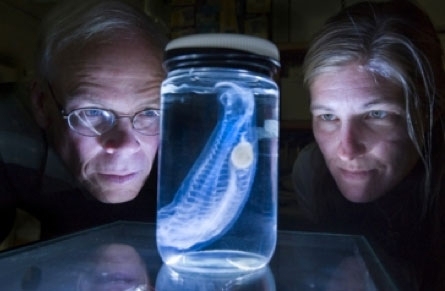
Such an energy-efficient, self-propelling mechanism already exists in nature. The salp, a smallish, barrel-shaped organism that resembles a kind of streamlined jellyfish, gets everything it needs from the ocean waters to feed and propel itself. And scientists believe its waste material may actually help remove carbon dioxide (CO2) from the upper ocean and the atmosphere.
Now, researchers at the Woods Hole Oceanographic Institution (WHOI) and MIT’s Department of Civil and Environmental Engineering (CEE) report that the half-inch to 5-inch-long creatures are even more efficient than had been believed. Reporting in the current issue of the Proceedings of the National Academy of Sciences, they have found that the ocean-dwelling salps are capable of capturing and eating extremely small organisms as well as larger ones, rendering them even hardier — and perhaps more plentiful — than had been thought.
Read more on CEE's website
Such an energy-efficient, self-propelling mechanism already exists in nature. The salp, a smallish, barrel-shaped organism that resembles a kind of streamlined jellyfish, gets everything it needs from the ocean waters to feed and propel itself. And scientists believe its waste material may actually help remove carbon dioxide (CO2) from the upper ocean and the atmosphere.
Now, researchers at the Woods Hole Oceanographic Institution (WHOI) and MIT’s Department of Civil and Environmental Engineering (CEE) report that the half-inch to 5-inch-long creatures are even more efficient than had been believed. Reporting in the current issue of the Proceedings of the National Academy of Sciences, they have found that the ocean-dwelling salps are capable of capturing and eating extremely small organisms as well as larger ones, rendering them even hardier — and perhaps more plentiful — than had been thought.
Read more on CEE's website