Professors Pedro Reis and Markus Buehler of the Department of Civil and Environmental Engineering (CEE) and CEE doctoral student Dipanjan Sen recently collaborated on a research project with Konstantin Novoselov, winner of this year's Nobel Prize in physics for his discovery of graphene (with Andre Geim). Graphene, a single-atom-thick sheet of graphite, is an exceedingly strong and highly conductive material.
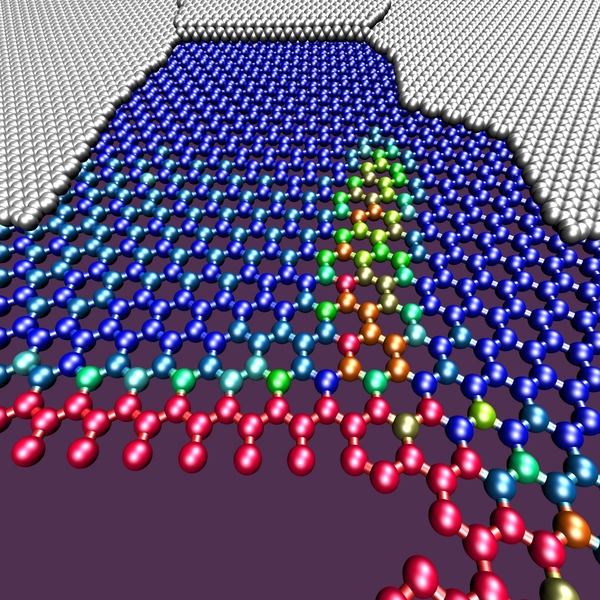
Reis, who also holds an appointment in the Department of Mechanical Engineering, knew Novoselov from the University of Manchester, and had co-authored a series of papers explaining the consistently triangular-shaped tears that occur when tape, wallpaper and other thin films are pulled away from a surface. Novoselov had observed similar shaped tears when scraping graphene ribbons from graphite. The researchers wondered if the analogous geometric shapes indicate that the behavior is controlled by the same mechanisms at these different scales. Buehler, who uses molecular dynamics simulation to explore materials at the nanoscale, and Sen worked with Reis and Novoselov to carry out atomistic-level simulations to explain the mechanics behind the triangular tears in graphene.
Read about the research results in the summer issue of the CEE research newsletter, On Balance
Reis, who also holds an appointment in the Department of Mechanical Engineering, knew Novoselov from the University of Manchester, and had co-authored a series of papers explaining the consistently triangular-shaped tears that occur when tape, wallpaper and other thin films are pulled away from a surface. Novoselov had observed similar shaped tears when scraping graphene ribbons from graphite. The researchers wondered if the analogous geometric shapes indicate that the behavior is controlled by the same mechanisms at these different scales. Buehler, who uses molecular dynamics simulation to explore materials at the nanoscale, and Sen worked with Reis and Novoselov to carry out atomistic-level simulations to explain the mechanics behind the triangular tears in graphene.
Read about the research results in the summer issue of the CEE research newsletter, On Balance