Skip to content ↓

Carbon-capturing enzyme: MIT chemists learn from nature

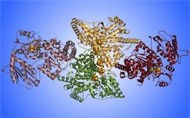
four clusters of coiled squiggles, denoting an enzyme structure
Credits:
Diagram courtesy of Yan Kung, MIT
Each year, microorganisms containing a certain enzyme remove an estimated 100 million tons of the pollutant carbon monoxide (CO) from the environment. Now, MIT researchers have new insights into how they go about it — happy news for inorganic chemists who have long been trying to synthesize compounds that can do the same thing without the living creature.

“Microorganisms such as bacteria can do lots of chemistry that people would like to do,” says Catherine L. Drennan, professor of chemistry and a Howard Hughes Medical Institute investigator. “They can form and break carbon bonds, split nitrogen, and break apart hydrogen and oxygen — all things that we can’t do or can do only with great difficulty.”

For the complete article, visit http://mitei.mit.edu/news/carbon-capturing-enzyme-mit-chemists-learn-nature


Related Links

Related Topics

More MIT News

Rich Nielsen, Volha Charnysh, Kevin Dorst, and Emily Richmond Pollock seated at a table, talking

Building a scholarly community

The SHASS Faculty Fellows Program, administered by the MIT Human Insight Collaborative, is fostering new research projects and creating space for supportive and interdisciplinary discussion.

Read full story

Globular blue and white orbs "examining" single-stranded RNA products and marking them with green checks or red x's

Why are some bacterial genes high in purines?

In certain species of bacteria, the answer lies in shielding RNA transcripts from a quality-control factor called Rho. Understanding the requirements for expressible sequences is critical for expression engineering of therapeutic agents.

Read full story