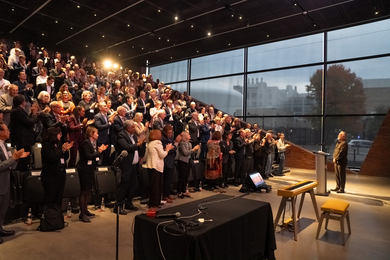
The Department of Urban Studies and Planning at MIT recently welcomed 17 fellows as part of the Special Program for Urban and Regional Studies (SPURS), a one-year program designed for mid-career professionals from newly industrializing countries.
Eleven of the new fellows were accepted through the Hubert H. Humphrey Fellowship Program, an exchange program initiated by the U.S. Congress in 1978 to honor the memory and accomplishments of the late Senator and Vice President, Hubert H. Humphrey. MIT is a host university for Humphrey fellows, through SPURS.
This year' s participants come from Afghanistan, Bosnia and Herzegovina, Estonia, Kosovo, Benin, Uganda, Zambia, Ghana, Turkey, Brazil, Colombia, Korea, China and Canada. The fellows come from both public and private sectors of developing countries around the world and are selected through a highly competitive international selection process for their commitment to, and experience in, fields such as city management, economic development, urban and regional planning, physical infrastructure planning, information technology policy and management, and law and human rights.
Â
As part of their contribution to the MIT community, the fellows are connected to MIT undergraduate and graduate students, most recently through International House (iHouse). Fellows mentor iHouse students, who benefit from their practice-oriented experience and learn about internship opportunities in the fellows' countries.
Since its inception in 1967, SPURS has hosted over 550 women and men from more than 90 countries in Latin America, Asia, Africa, the Middle East, and Eastern and Central Europe. The program is directed by Professor Bish Sanyal of the Department of Urban Studies and Planning.
A version of this article appeared in MIT Tech Talk on October 22, 2008 (download PDF).