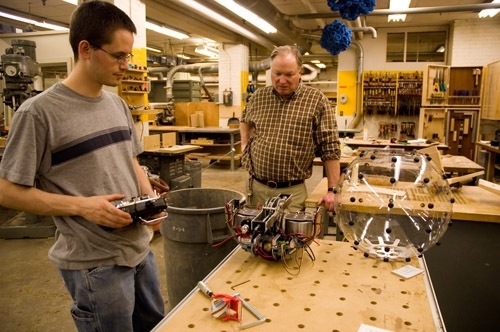
A student project built in the MIT Hobby Shop has earned its creator honors from Popular Mechanics as one of the magazine’s “Top 10 Most Brilliant Innovators of 2009.”
Greg Schroll, a mechanical engineering major who graduated in 2008, is the inventor of a remote-control, ball-shaped robot with impressive navigational ability, even in rough terrain. Working with his thesis advisor, mechanical engineering professor Alex Slocum ’82, SM ’83, PhD ’85, Schroll constructed his prototype in the legendary workshop.
“Greg has a huge amount of knowledge and skills, and this project was beautifully executed,” said Hobby Shop Director Ken Stone ’72, who is travelling to New York City this week to watch Schroll receive his award. “Greg came to MIT because he saw that we had facilities for him to build things on his own, outside of his academic work.”
Lauded by the magazine as “MIT’s famously well-equipped Hobby Shop,” the facility is a wood and metal shop open to the entire MIT community. Students, faculty, staff, and alumni can use the shops diverse array of machines and power tools to work on projects that range from academic to personal and from serious to just-for-fun.
To read about Scholl’s invention in Popular Mechanics, visit: http://www.popularmechanics.com/science/robotics/4332921.html
To learn about the MIT Hobby Shop, visit: http://hobbyshop.mit.edu/