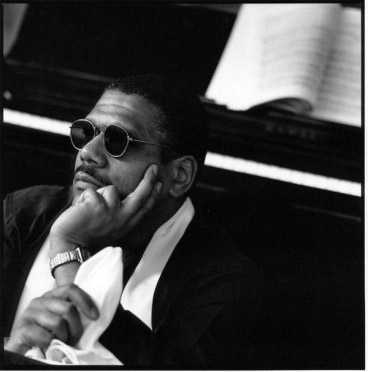
MLK Visiting Scholar Donal Fox performed the world premiere of his concerto "Peace Out for Improvised Piano and Orchestra" at Carnegie Hall on Monday, Nov. 30, as part of a program titled "Traditions and Transmigrations."
Fox received a standing ovation from the Carnegie Hall audience for his performance and composition, and a glowing review from Anthony Tommasini at The New York Times. Calling the concerto "exceptionally interesting," Tommasini writes:
"Mr. Fox, a composer, pianist and improviser who deftly draws from jazz and classical contemporary traditions, was the soloist in his intense, episodic 15-minute work. The blazingly scored orchestra part is fully composed. But the piano part, though well plotted, includes swaths of improvised, interactive music ... The piece opens with a fitful section, all gnashing brass, spiraling strings and searing harmonic angst. Mr. Fox’s piano playing, bursting with violent, keyboard-spanning runs, drove the music. A searching middle section quotes fragments of a Charlie Parker blues tune, 'Now’s the Time.' After a steely solo piano cadenza, the piece concludes with a pensive finale based on a descending, and strangely haunting, four-note refrain."
As an MLK Visiting Scholar, Fox is based in the School of Humanities, Arts, and Social Sciences, where he is giving a Music and Theater Arts class in musical improvisation, guiding students as they examine relationships between improvisation, composition and performance from a score. Commenting on the class, Peter Child, MIT professor of music, says, "The results have been amazing."
Fox received a standing ovation from the Carnegie Hall audience for his performance and composition, and a glowing review from Anthony Tommasini at The New York Times. Calling the concerto "exceptionally interesting," Tommasini writes:
"Mr. Fox, a composer, pianist and improviser who deftly draws from jazz and classical contemporary traditions, was the soloist in his intense, episodic 15-minute work. The blazingly scored orchestra part is fully composed. But the piano part, though well plotted, includes swaths of improvised, interactive music ... The piece opens with a fitful section, all gnashing brass, spiraling strings and searing harmonic angst. Mr. Fox’s piano playing, bursting with violent, keyboard-spanning runs, drove the music. A searching middle section quotes fragments of a Charlie Parker blues tune, 'Now’s the Time.' After a steely solo piano cadenza, the piece concludes with a pensive finale based on a descending, and strangely haunting, four-note refrain."
As an MLK Visiting Scholar, Fox is based in the School of Humanities, Arts, and Social Sciences, where he is giving a Music and Theater Arts class in musical improvisation, guiding students as they examine relationships between improvisation, composition and performance from a score. Commenting on the class, Peter Child, MIT professor of music, says, "The results have been amazing."