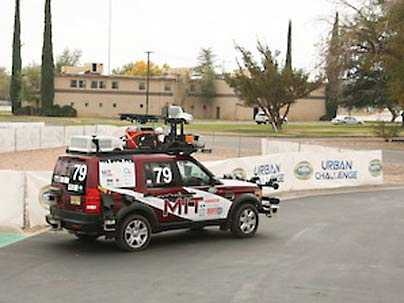
Team MIT has made it to the finals of the DARPA Urban Challenge, a competition for cars and trucks that run without human help. The qualification was announced Thursday, Nov. 1, by DARPA, the Defense Advanced Research Projects Agency, who is sponsoring the competition with the goal of developing vehicles that can operate on their own in battle and keep humans out of harm's way.
The announcement means the MIT vehicle--a self-piloted Land Rover LR3 dubbed "robocar"--and its team of student and faculty developers will compete in the finals Saturday in Victorville, Calif. DARPA plans to recognize the top three finishers Sunday with awards of $2 million, $1 million, and $500,000.
"Our team is absolutely thrilled to be invited to participate in the race," said team leader John Leonard, professor of mechanical and ocean engineering at MIT. "My co-PI's Jon How, Seth Teller, David Barrett and I would like to extend our heartfelt thanks to our students and staff, who have done a phenomenal job in creating a highly innovative autonomous vehicle in just 18 months. We also thank our sponsors who helped us to make it this far, and our families who made tremendous sacrifices in supporting us to undertake this project. We look forward to the challenge of trying to finish the 60 mile race course on Saturday."
The semifinals, which were held from Oct. 26-31, evaluated some three dozen robotic vehicles on their ability to operate in traffic without human intervention while obeying California traffic laws. The vehicles had to operate simulated military supply missions, at the same time performing routine operations such as negotiating left turns and roadblocks.
The MIT vehicle uses multiple laser range scanners, high-rate video cameras and automotive radar units to perform autonomous planning and motion control.
In addition to Leonard, key members of the MIT team include Professor Jonathan How and Associate Professor Emilio Frazzoli of the MIT Department of Aeronautics and Astronautics, Professor Seth Teller of the MIT Department of Electrical Engineering and Computer Science and Associate Professor David Barrett of Olin College. The team also includes engineers from the C.S. Draper Laboratory and a team of undergraduates from Olin College.
This is the first year MIT has competed in the DARPA Urban Challenge.