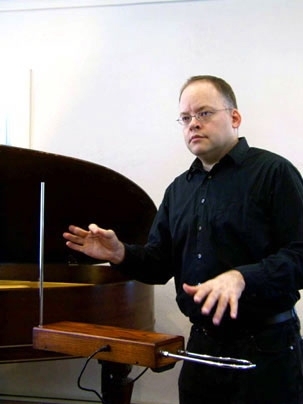
Forget the roses and violins. In a special noontime concert on Valentine's Day called "Waves of Pleasure," Assistant Professor Brian Robison will wave his hands over a theremin to create other-worldly renditions of popular romantic classics by Handel, Puccini and Rachmaninoff, as well as contemporary favorites by Ellington, Gershwin and Rodgers.
Also featuring lecturer Charles Shadle as piano accompanist, the concert will be held in the Lewis Music Library (Room 14E-109) on Tuesday, Feb. 14 from 12 to 1 p.m.
One of the earliest electronic musical instruments, the theremin is unique in that the performer doesn't touch it while playing. Instead, proximity of the performer's hands to two antennae control the pitch and volume.
Robison first encountered a theremin in a music store about a decade ago. "I was hopelessly unable to produce any recognizably musical sound," he recalls, but he decided last fall that the instrument was just too much fun not to have one.
Calling the theremin "maddeningly difficult to play accurately," Robison notes that it requires extremely fine motor control. "If your hand drifts just a millimeter or two in space, that motion produces a noticeable change in pitch," he says.
The concert will include an opportunity for adventurous audience members to try the instrument.
"There's something mesmerizing about playing an instrument that responds to your every move, whether you want it to or not," Robison says. "I keep coming back to the theremin -- despite the limitations, despite the frustration, despite the humiliation. Much like love."
A version of this article appeared in MIT Tech Talk on February 8, 2006 (download PDF).