Skip to content ↓

Culpepper honored at White House

Press Contact:

Elizabeth A. Thomson
Phone: 857-756-9457
MIT Materials Research Laboratory

Media Download

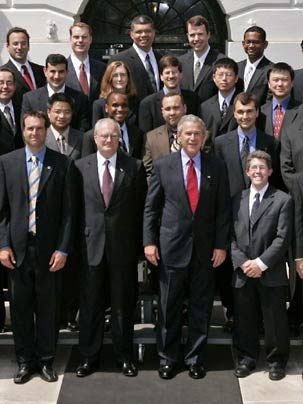
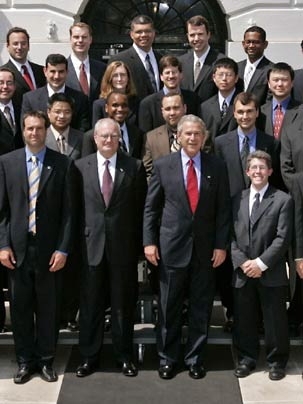
Assistant Professor Martin L. Culpepper, in the center of the top row, poses with President Bush and fellow winners of the 2004 Presidential Early Career Awards for Scientists and Engineers in front of the White House on June 13.
Download Image
Caption: Assistant Professor Martin L. Culpepper, in the center of the top row, poses with President Bush and fellow winners of the 2004 Presidential Early Career Awards for Scientists and Engineers in front of the White House on June 13.
Credits: Photo / Paul Morse, White House

*Terms of Use:

Images for download on the MIT News office website are made available to non-commercial entities, press and the general public under a Creative Commons Attribution Non-Commercial No Derivatives license. You may not alter the images provided, other than to crop them to size. A credit line must be used when reproducing images; if one is not provided below, credit the images to "MIT."

Close
Assistant Professor Martin L. Culpepper, in the center of the top row, poses with President Bush and fellow winners of the 2004 Presidential Early Career Awards for Scientists and Engineers in front of the White House on June 13.
Caption:
Assistant Professor Martin L. Culpepper, in the center of the top row, poses with President Bush and fellow winners of the 2004 Presidential Early Career Awards for Scientists and Engineers in front of the White House on June 13.
Credits:
Photo / Paul Morse, White House

Assistant Professor Martin L. Culpepper was honored at a White House ceremony with President Bush last month as one of 58 researchers to receive 2004 Presidential Early Career Awards for Scientists and Engineers.

The PECASE is the nation's highest honor for young professionals starting their research careers. Eight federal departments and agencies annually nominate young scientists and engineers expected to broadly advance science and technology that will be of the greatest benefit to those agencies.

Culpepper, of the Department of Mechanical Engineering, was nominated by the National Science Foundation. According to the NSF, he is "involved in research to advance the understanding of nanoscale positioning and manipulation, a critical element toward creating production-scale manufacturing and inspection processes and products."

"He gains valuable insights through close collaborations with automakers and photonics manufacturers. His creative education efforts include developing a hands-on undergraduate course in machine dissection and design, precision manipulation, and microelectromechanical system design and fabrication."

Culpepper is also cited for serving as "a mentor to minority students through many activities and organizations."

PECASE awardees receive funding for up to five years to further research in support of critical government missions.

The White House event was held June 13.
Related Links

Related Topics

More MIT News

Globular blue and white orbs "examining" single-stranded RNA products and marking them with green checks or red x's

Why are some bacterial genes high in purines?

In certain species of bacteria, the answer lies in shielding RNA transcripts from a quality-control factor called Rho. Understanding the requirements for expressible sequences is critical for expression engineering of therapeutic agents.

Read full story

Rich Nielsen, Volha Charnysh, Kevin Dorst, and Emily Richmond Pollock seated at a table, talking

Building a scholarly community

The SHASS Faculty Fellows Program, administered by the MIT Human Insight Collaborative, is fostering new research projects and creating space for supportive and interdisciplinary discussion.

Read full story