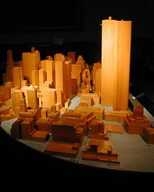
As part of its participation in the American Association of Museums' "Museums Celebrate America's Freedoms: Joining Communities in a Day of Remembrance" on Sept. 11, the MIT Museum is offering free admission and displaying a 1975 scale model of lower Manhattan. The label for the model, which will be on display through Sept. 15, reads:
Battery Park City, 1:600 scale model, 1975
Built by Earle Wassmouth, Wright Brothers Wind Tunnel staff
MIT's Department of Aeronautics and Astronautics gained a national reputation for its work on the impact of wind on buildings during the early 1970s. In 1975 the Battery Park City Authority contracted with the MIT Wright Brothers Memorial Wind Tunnel to investigate pedestrian level winds in three proposed apartment complexes in Battery Park City. With the demolition of the West Side Drive in that area, there were whipping wind conditions that New York officials hoped could be eliminated or lessened with the proposed Battery Park City buildings. Supervised by Professor Eugene Covert, the wind tunnel staff conducted a 14-month research project that was completed in June 1976.
A 1:600 scale model of lower Manhattan, including the new World Trade Center towers was built. The model was put into the wind tunnel and smoke used to find where the high velocity winds occurred. Hot wires were then used to measure pedestrian level winds at 108 test locations in the site for winds from twelve different directions. After studying the results of the first series of tests, the Battery City Park Authority, following suggestions from the wind tunnel staff, proposed numerous architectural changes. A second series of wind tunnel tests confirmed the general effectiveness of all but one of those changes.