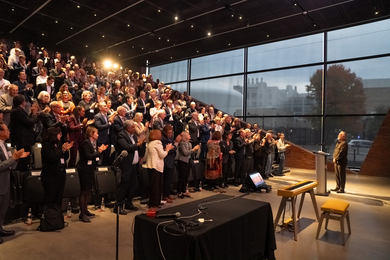
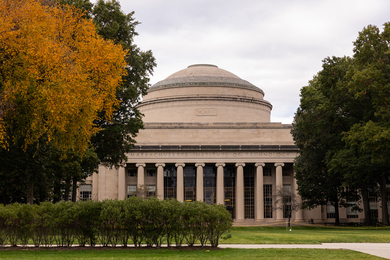
A memorial service for Charles L. Miller, the former head of the Department of Civil and Environmental Engineering who died last February, will be held on Wednesday, Nov. 15 at 1:30pm in the MIT Chapel. Immediately following the service there will be an informal reception in the Spofford Room (1-236).
Professor Miller died in his Tampa, FL home on February 29 at age 70 following a long illness.
In 1969 Professor Miller was named head of the Department of Civil Engineering at MIT. At age 32, he was the youngest faculty member ever to head the department, and he played an important role in revising the department's curriculum. He helped usher civil engineering into the computer age by developing methods of using computers to analyze data for locating highways, and in 1961 developed COGO, the first computer program for topographical surveying and an early forerunner of CAD programs. COGO was later incorporated into Professor Miller's Integrated Civil Engineering System (ICES), which placed computing power into the hands of designers in many engineering fields.
In 1960 he founded MIT's Civil Engineering Systems Laboratory, the first in the country. From 1968-77 he was founder and director of the Urban Systems Laboratory at MIT, an interdepartmental lab for research into engineering, planning and management. In 1970 he was named associate dean of engineering and interim director of the Charles Stark Draper Laboratory, a post he held for one year during the lab's transition from MIT's Instrumentation Lab into an independent research lab. He left MIT in 1977 to run his own company, CLM/Systems, Inc. in Tampa.
A version of this article appeared in MIT Tech Talk on November 1, 2000.