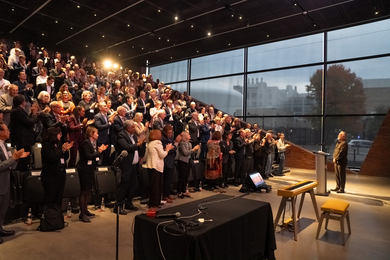
Officials from environmental organizations and MIT recently gathered on the banks of the Charles River to mark progress by the Clean Charles 2005 Coalition toward a swimmable and fishable river within five years. Speakers included Mindy S. Lubber (at podium), regional administrator at the EPA's New England office; Paul Parravano (second from left), co-director of MIT's Office Of Government and Community Relations; and Bob Zimmerman (third from left), exeutive director of the Charles River Watershed Association. Coalition member MIT has donated a boat to help with water sampling, and Dan Delisi, a graduate student in urban studies and planning, has been working with the EPA to design a stormwater-management ideas competition.
Credits:
Photo / Donna Coveney
Caption:
Institute Professor Mario Molina gives the keynote address at "Environment and Development in an Unequal World," an April 13 event that included a book release for Green Politics: Global Environmental Negotiations by the Center for Science and Environment in New Delhi, and a panel discussion with scientists from MIT and India. The event was sponsored by Sangam, PAKSMIT (the Pakistani Students Society at MIT), the Social Justice Cooperative, SAVE (Share a Vital Earth), AID-Boston, the Department of Earth, Atmospheric and Planetary Science's Mexico City Project and Boston University's Center for Energy and Environment Studies.
Credits:
Photo / Laura Wulf
A version of this article appeared in MIT Tech Talk on April 26, 2000.
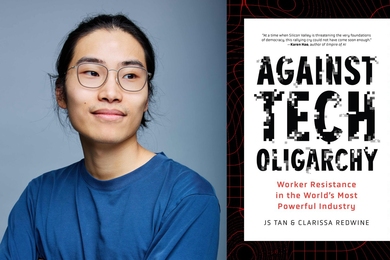
Writing as a participant and researcher, PhD student JS Tan SM ’22 has co-authored a new book about the rise of tech worker protests and the employer backlash that followed.