Department
Electrical Engineering and Computer Science
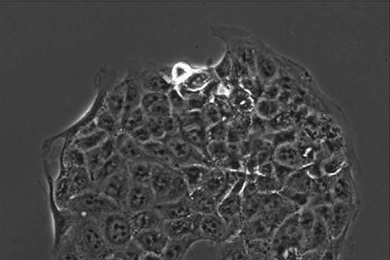
How cancer cells break free from tumors
New MIT study identifies adhesion molecules key to cancer’s spread through the body.
What number is halfway between 1 and 9? Is it 5 — or 3?
A new information-theoretical model of human sensory perception and memory sheds light on some peculiarities of the nervous system.
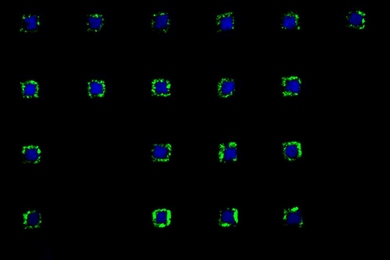
Replicating living structures
Research examines how to control spatial distribution of cells in microenvironments
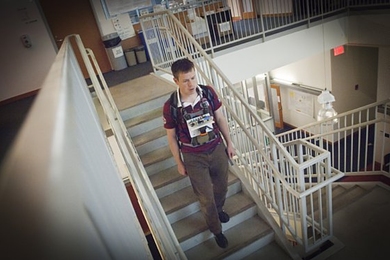
Automatic building mapping could help emergency responders
A prototype sensor array that can be worn on the chest automatically maps the wearer’s environment, recognizing movement between floors.
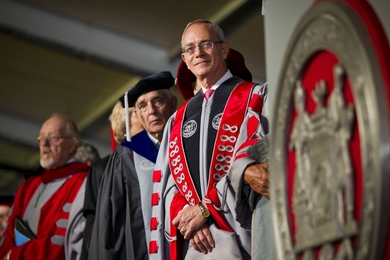
‘We are all in this great enterprise together’
In his inaugural address, President L. Rafael Reif aims MIT on a course to shape new directions in education.

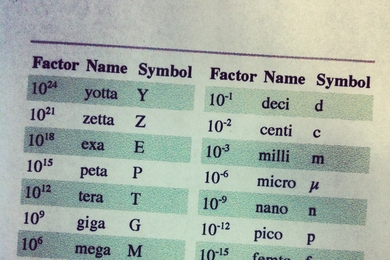
Explained: Femtoseconds and attoseconds
As electronic and optical devices get ever faster, terms for ever-smaller increments of time are coming into wider use.
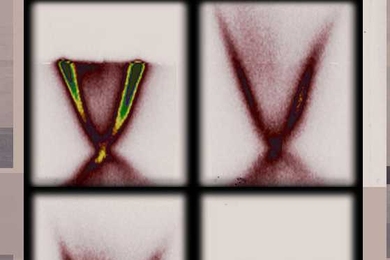
Watching electrons move at high speed
New MIT system allows femtosecond-resolution movie of electrons in a topological insulator, a promising new electronic material.
CSAIL research examines how smartphone apps track users
Decentralized Information Group shows that many applications collect data even when 'idle'
Fujimoto, Swanson awarded the 2012 António Champalimaud Vision Award
Share honor with colleagues for pioneering work in the development of optical coherence tomography.

World-class musician Mark Stewart comes to the Glass Lab
In a yearlong residency, the musician and instrument designer will build a glass orchestra with MIT students.


Leonard A. Gould, EECS emeritus professor, dies at 85
Joined MIT faculty in 1953; studied control problems and dynamic modeling.
U.S. News ranks MIT sixth overall among U.S. universities
Institute’s undergraduate engineering program is again ranked No. 1; undergraduate business program is No. 2.