John D. Joannopoulos, the Francis Wright Davis Professor of Physics and Director of the Institute for Soldier Nanotechnologies, has been awarded the 2015 Aneesur Rahman Prize for Computational Physics of the American Physical Society.
Given annually to recognize "outstanding achievement in computational physics research," the prize includes a cash award and invitation to deliver the Society’s annual Rahman Lecture.
Joannopoulos’ research spans two major directions. The first is creating a realistic and microscopic theoretical description of the geometric, electronic, and dynamical structure properties of material systems.
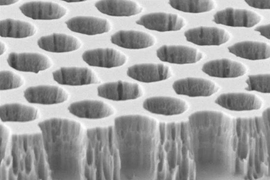
The second centers on the development of a new class of materials, "photonic crystals," designed to control light with remarkable facility, and to produce effects impossible to create with conventional optics.
Among numerous honors and awards, Joannopoulos is a member of the National Academy of Sciences, a fellow of the American Association for the Advancement of Science, and has received Alfred P. Sloan and John S. Guggenheim fellowships, as well as the Department of Physics’ William Buechner Teacher Prize and the School of Science’s Graduate Teaching Award. He is ranked by Thompson ISI as one of its most "Highly Cited Researchers."