An engineer’s guide to birds
In her new book, “Birds Up Close,” MIT materials engineer Lorna Gibson explores feathers, bones, bills, eggs, and flight, and the mechanics behind birds’ extraordinary abilities.
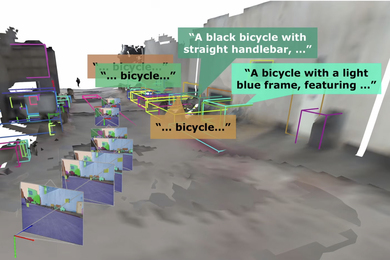
Solving the “Whac-a-mole dilemma”: A smarter way to debias AI vision models
A new debiasing technique called WRING avoids creating or amplifying biases that can occur with existing debiasing approaches.
MIT engineers’ virtual violin produces realistic sounds
Based on the physics of how the instrument produces sound, the model could help violin makers in the design process.
Enabling privacy-preserving AI training on everyday devices
A new method could bring more accurate and efficient AI models to high-stakes applications like health care and finance, even in under-resourced settings.
With a swipe of a magnet, microscopic “magno-bots” perform complex maneuvers
MIT researchers’ new fabrication technique can produce soft, microscopic structures with magnetically activated moving parts.
Mapping molecular markers of physical fitness
A new study reveals cellular pathways that appear to underlie some differences in physical fitness.
Six from MIT awarded 2026 Paul and Daisy Soros Fellowships for New Americans
Fellowship honors contributions of immigrants to American society by awarding $90,000 in funding for graduate studies.
Self-organizing “pencil beam” laser could help scientists design brain-targeted therapies
MIT researchers leveraged a surprise discovery to devise a faster and more precise biomedical imaging technique.
A faster way to estimate AI power consumption
The “EnergAIzer” method generates reliable results in seconds, enabling data center operators to efficiently allocate resources and reduce wasted energy.
MIT scientists build the world’s largest collection of Olympiad-level math problems, and open it to everyone
New dataset of 30,000-plus competition math problems from 47 countries gives AI researchers a harder test — and students worldwide a better training ground.
Three from MIT named 2026 Goldwater Scholars
Rising seniors Deeksha Kumaresh, Anna Liu, and Charlotte Myers are honored for their academic achievements.
New chip can protect wireless biomedical devices from quantum attacks
Ultra-efficient chip design enables extremely strong cryptography algorithms to run on energy-constrained edge devices.
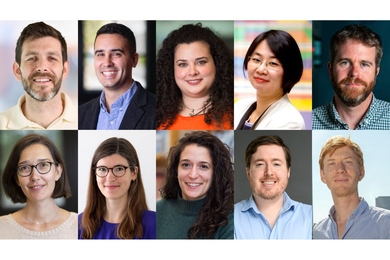
MIT affiliates elected to the American Academy of Arts and Sciences for 2026
The prestigious honor society honors four MIT faculty and 13 additional MIT alumni among more than 250 new members.
Teaching AI models to say “I’m not sure”
A new training method improves the reliability of AI confidence estimates without sacrificing performance, addressing a root cause of hallucination in reasoning models.