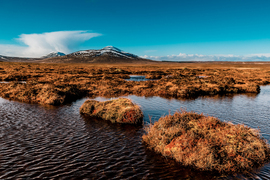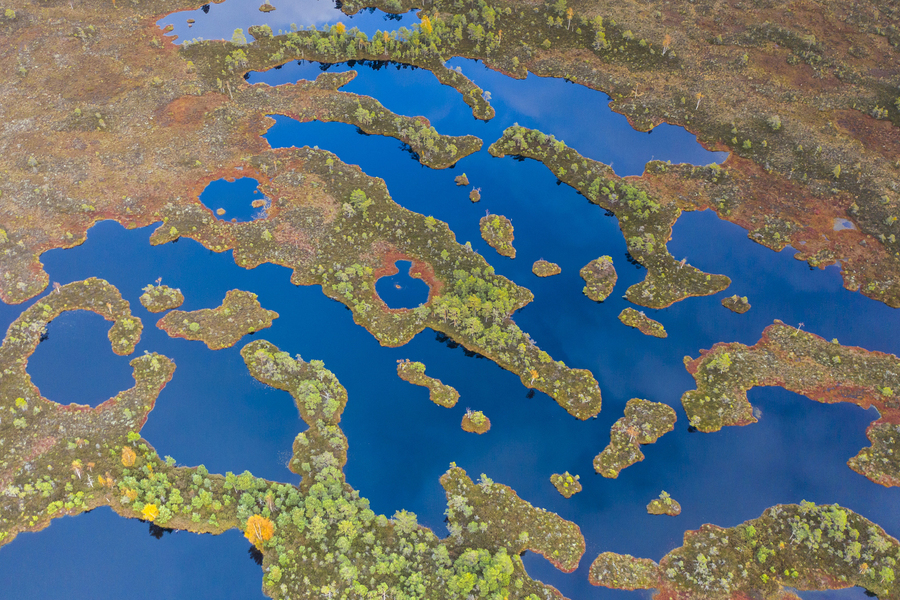
Peatland ecosystems like bogs and swamps perform an important balancing act: Their vegetation takes up huge amounts of carbon dioxide, while their soil microbes produce methane. Although methane is a potent greenhouse gas, peatlands exhibit a net cooling effect on the planet because of the sheer scale of carbon dioxide they remove from the atmosphere, which has amounted to hundreds of gigatons globally over thousands of years.
That balancing act is shattered when peatlands are drained, which has been happening with increasing speed over the last 200 years as people seek to use the land for agriculture, forestry, and other development. But the global impact of peatland drainage on greenhouse gas emissions and climate change has been difficult to calculate.
Now MIT researchers have combined data on worldwide drainage with models on how carbon dioxide and methane emissions change as a result of drainage. In a study published today in Nature, they estimate that the drainage of peatlands around the world has contributed about 2.7 percent of present-day human-caused warming.
The researchers say the work makes clear how important peatlands are to climate and adds support for peatland restoration projects across the globe.
“The hope is that these results are a wakeup call for policymakers and people responsible for restoring land,” says César Terrer, an MIT associate professor of civil and environmental engineering. “The first message is to stop draining peatlands, because a drained peatland can keep emitting carbon dioxide for centuries. The second is to restore the peatlands that are already drained, which means raising their water table.”
Joining Terrer on the paper are first author Jevan Yu, an MIT doctoral student in civil and environmental engineering; Etienne Fluet-Chouinard, an earth scientist at Pacific Northwest National Laboratory; Susan Page, a professor at the University of Leicester; Chris Evans, a biogeochemist at the UK Center for Ecology and Hydrology; and Charles Harvey, an MIT professor of civil and environmental engineering.
Calculating emissions tradeoffs
Peatlands are wet, oxygen-poor ecosystems that hold huge amounts of partially decayed plant matter, which accumulates as peat. Today they store about 30 percent of the world’s soil carbon despite accounting for only 3 or 4 percent of the planet’s land surface. That’s more than the carbon stored in all the world’s forests combined.
Humans have been draining peatlands for centuries, but the pace has picked up since the Industrial Revolution, especially in Southeast Asia and Europe.
In 2013, the Intergovernmental Panel on Climate Change published a large set of data on emissions from drained peatlands in different parts of the world, which helped researchers begin to piece together the climate impact of draining peatlands.
Draining peatlands exposes their plant matter to oxygen, which releases carbon dioxide for hundreds of years as microbes break down the newly dry soil. It’s generally been assumed that, because of the CO2 release, drainage leads to a net warming effect, despite the fact that it suppresses microbial methane emissions, but the extent hasn’t been determined yet.
“Peatland drainage features these opposing effects in terms of warming potential,” Terrer says.
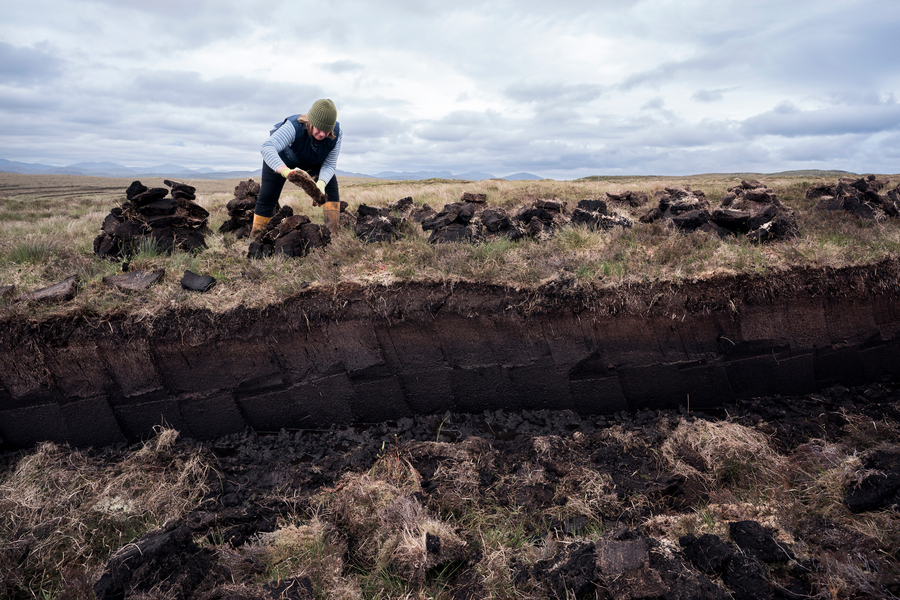
To quantify the effects of peatland drainage, the researchers quantified the timing and extent of peatland drainage from 1800 to 2020. They also aggregated a new dataset on emissions from different types of drained peatlands to expand on the IPCC’s emissions estimates. The analysis considered emissions changes at the peat surface as well as in the ditches peatland water drains into, which can be a potent source of methane.
Finally, the researchers combined these datasets with models of greenhouse gas fluxes to quantify the impact of peatland drainage since 1800.
They found that drainage of about 0.5 percent of the world’s land surface — or about 15 percent of all peatland area — is responsible for about 2.7 percent of the warming influence of human activities since the Industrial Revolution. Even without draining more peatlands, maintaining currently drained peatlands could almost double the cumulative warming caused by peatlands by 2100.
“Peatlands have slow decomposition because they are waterlogged, and that allows these ecosystems to accumulate very dense deposits of organic carbon that, when drained, can release carbon dioxide for a very long time,” Yu says.
The study also looked at the drivers of carbon dioxide changes, including the depth of the water-saturated zone in the soil, also known as the water table.
“We developed these models of fluxes as a function of water table depth, and with estimates of drainage extent and depth, we can estimate changes in emissions relative to a baseline had they not been drained,” Yu says. “The water table depth is really the regulator of low-oxygen conditions.”
“Raising the water table would not remove the warming already caused, but it would avoid part of the warming that drained peatlands would otherwise add this century,” Terrer says.
An underappreciated problem
The researchers say the opposing emissions factors and long timescales associated with peatland drainage may have caused it to be overlooked in the effort to mitigate climate change.
“What makes peatland drainage unique compared to other land use changes like deforestation is when you knock down trees, the carbon either gets respired or used, but then the biomass is gone and there’s no continued CO2 emissions unless other activity is going on,” Terrer says. “Whereas peatland drainage continues releasing emissions from these huge, dense stocks of carbon being oxidized by microbes. There is so much carbon in these peatlands that as long as they’re exposed to the air, they are going to continue contributing to global warming.”
The researchers say the models used to estimate emissions will continue to be improved, and they plan to explore how other factors in peatlands beyond the water depth influence emissions. Still, the researchers hope others will use their database of fluxes and build on it.
“This can be used as a hypothesis testing playground for people, especially as the dataset grows,” Yu says.