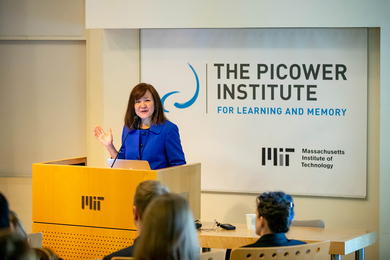
After 16 years leading Picower Institute, Li-Huei Tsai will sharpen focus on research, teaching
Tsai, who has grown the MIT neuroscience institute, will increase focus on research including Alzheimer’s disease and Down syndrome.
Tsai, who has grown the MIT neuroscience institute, will increase focus on research including Alzheimer’s disease and Down syndrome.
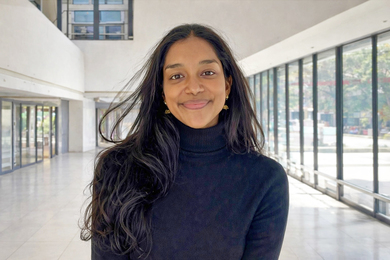
MIT senior Srihitha Dasari reflects on the power of experiential learning through the PKG Center for Social Impact.
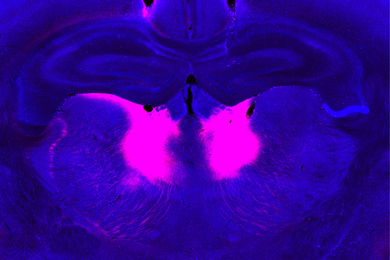
Impairments of this circuit may help to explain why some people with schizophrenia lose touch with reality.
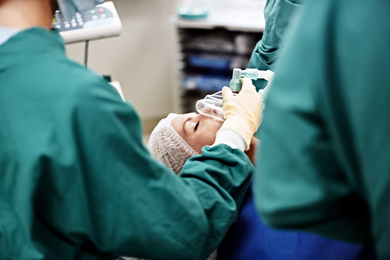
Discovering this common mechanism could lead to a universal anesthesia-delivery system to monitor patients more effectively.
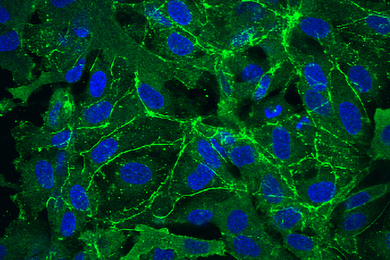
By showing the problem derives from genetic mutations that lead to overexpression of a microRNA, MIT researchers’ study points to potential treatment.
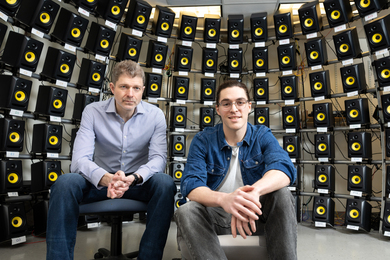
Using a computational model, neuroscientists showed how the brain can selectively focus attention on one voice among others in a noisy environment.

New work suggests the brain can deliver neuron-specific feedback during learning — resembling the error signals that drive machine learning.

Offering substantial prize funding alongside workshops, classes, and mentorship, the initiative helps translate early-stage biotech research into venture-ready innovation.
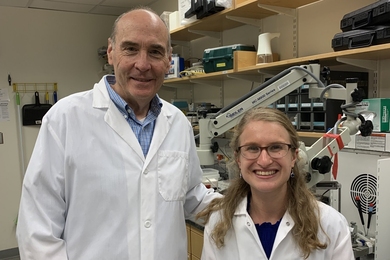
Researchers find mice modeling the autism spectrum disorder fragile X syndrome exhibit the same pattern of differences in low-frequency waves as humans — a new marker for treatment studies.
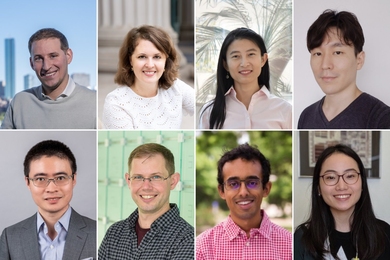
Annual award honors early-career researchers for creativity, innovation, and research accomplishments.
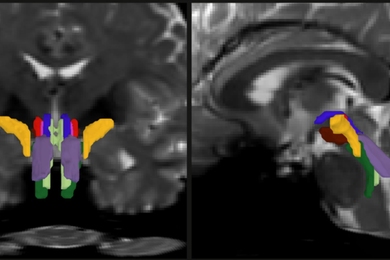
Opening a new window on the brainstem, a new tool reliably and finely resolves distinct nerve bundles in live diffusion MRI scans, revealing signs of injury or disease.
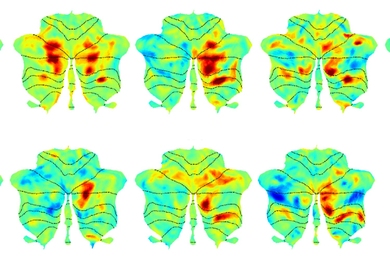
Researchers find a component of the brain’s dedicated language network in the cerebellum, a region better known for coordinating movement.
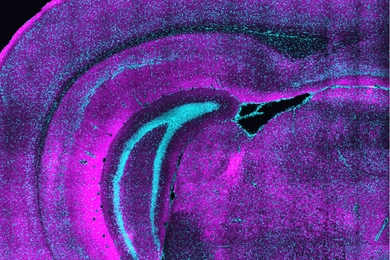
Somatostatin-expressing neurons follow a unique trajectory when forming connections in the visual cortex that may help establish the conditions needed for sensory experience to refine circuits.
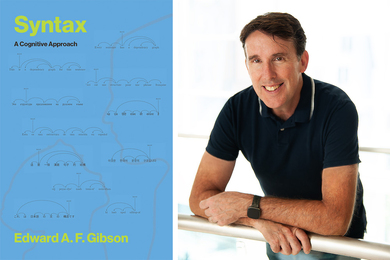
A new book by Professor Ted Gibson brings together his years of teaching and research to detail the rules of how words combine.
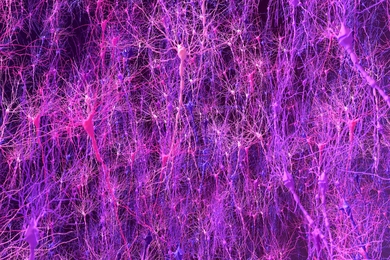
New “biomimetic” model of brain circuits and function at multiple scales produced naturalistic dynamics and learning, and even identified curious behavior by some neurons.