That China is an engine behind 21st-century growth is beyond conventional wisdom at this point, but a few numbers from Vale — the second-largest mining company in the world — show just how strong the shift from West to East has been, according to the company’s former CEO, Roger Agnelli, who spoke at MIT Sloan Wednesday.
In 2001, Brazil-based Vale did about 65 percent of its business between Europe and Brazil, combined. Today Europe and Brazil together account for only 17 percent of business, Agnelli said during the Dean’s Innovative Leader Series talk.
Currently, it’s China where the bulk of the work, 60 percent, is done, Vale said. Overall, Asia makes up about 80 percent of the company’s work.
“Can you imagine the transformation for that?” Agnelli asked. “I can tell you China is not a bubble. China is a reality. China is an opportunity.”
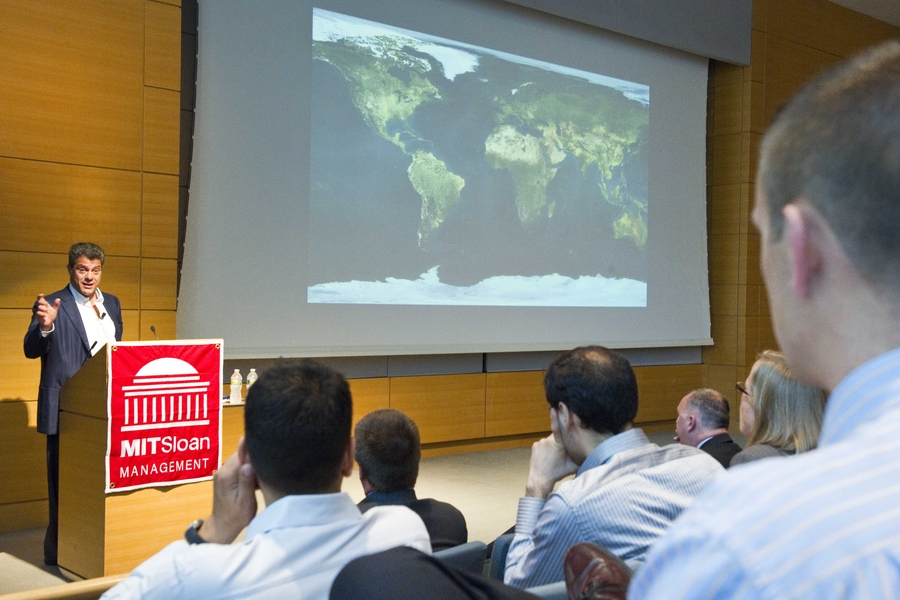
The talk, “Re-launching the Global Economy,” was accompanied by a projection of a world map where Agnelli’s hovered frequently over three regions: China; resource-rich South America; and underdeveloped Africa.
Agnelli posited Africa will be home to the “next battle for natural resources,” given its potential for agricultural and industrial development, as well as its relatively close proximity to Asia. He called for investments to develop Africa, arguing the continent can vault off low biomass production costs and improvements in agricultural technology to show significant, sustained growth.
“The only continent that can compete with South America with regards to natural resources is Africa,” Agnelli said.
The global natural resources market will remain tight for at least another decade, Agnelli also noted, as China’s growth continues and the Chinese look to Africa and elsewhere to sustain that growth.
“Thank God,” he said. “I pray every day for China. Keep growing.”
Agnelli took over as CEO at Vale in 2001, after a 14-month stint on the company’s board of directors. Vale is Brazil’s largest exporter, with a market cap of $180 billion, operations in 32 countries and 145,000 employees globally.
The MIT Sloan Dean’s Innovative Leader Series brings the world’s most influential leaders to campus for lectures and discussions with students. Upcoming talks include Ellen Kullman, chair of the board and CEO at Dupont, and Gary Hirshberg, chairman, president and CE-Yo at Stonyfield Farm.
In 2001, Brazil-based Vale did about 65 percent of its business between Europe and Brazil, combined. Today Europe and Brazil together account for only 17 percent of business, Agnelli said during the Dean’s Innovative Leader Series talk.
Currently, it’s China where the bulk of the work, 60 percent, is done, Vale said. Overall, Asia makes up about 80 percent of the company’s work.
“Can you imagine the transformation for that?” Agnelli asked. “I can tell you China is not a bubble. China is a reality. China is an opportunity.”
The talk, “Re-launching the Global Economy,” was accompanied by a projection of a world map where Agnelli’s hovered frequently over three regions: China; resource-rich South America; and underdeveloped Africa.
Agnelli posited Africa will be home to the “next battle for natural resources,” given its potential for agricultural and industrial development, as well as its relatively close proximity to Asia. He called for investments to develop Africa, arguing the continent can vault off low biomass production costs and improvements in agricultural technology to show significant, sustained growth.
“The only continent that can compete with South America with regards to natural resources is Africa,” Agnelli said.
The global natural resources market will remain tight for at least another decade, Agnelli also noted, as China’s growth continues and the Chinese look to Africa and elsewhere to sustain that growth.
“Thank God,” he said. “I pray every day for China. Keep growing.”
Agnelli took over as CEO at Vale in 2001, after a 14-month stint on the company’s board of directors. Vale is Brazil’s largest exporter, with a market cap of $180 billion, operations in 32 countries and 145,000 employees globally.
The MIT Sloan Dean’s Innovative Leader Series brings the world’s most influential leaders to campus for lectures and discussions with students. Upcoming talks include Ellen Kullman, chair of the board and CEO at Dupont, and Gary Hirshberg, chairman, president and CE-Yo at Stonyfield Farm.