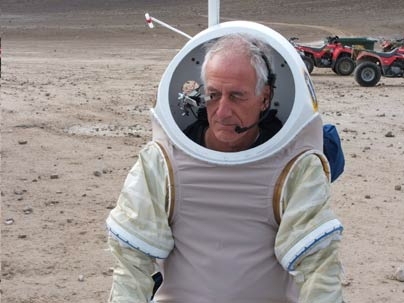
Jeffrey Hoffman, a professor of the practice in MIT's Department of Aeronautics and Astronautics, will be inducted into the U.S. Astronaut Hall of Fame on May 5.
Hoffman was a project scientist at the Center for Space Research in 1978 when he was among the first group of astronauts chosen for NASA's new space shuttle program.
This year's other two inductees--Michael Coats and Steven Hawley--were also members of NASA's 1978 astronaut class. That class, nicknamed the "Thirty-Five New Guys," was the first selected to fly shuttle missions.
Hoffman, 62, is a veteran of five shuttle flights, including a make-or-break mission to repair the myopic Hubble Space Telescope in 1993.
Hoffman and three other astronauts staged an unprecedented five spacewalks in five days to fix the four-story telescope, which now is responsible for more than 40 percent of the scientific discoveries made by NASA researchers.
Hoffman's first flight, aboard Discovery in April 1985, included the first contingency space walk in shuttle program history and a brake failure and blown tire during the landing at Kennedy Space Center.
He also flew two flights to test the Italian-made Tethered Satellite System. The highly experimental missions ultimately proved that electricity could be generated by dragging a tethered satellite through Earth's magnetic field.
In 1997, Hoffman moved to Paris to serve as NASA's prime liaison with the European Space Agency. In 2001, he came to MIT, where he is a professor of the practice in aerospace engineering and teaches courses in space operations and spacecraft design.
A version of this article appeared in MIT Tech Talk on January 24, 2007 (download PDF).