Skip to content ↓

Nature-al selection

Sept. 29 <a onclick="MM_openBrWindow('nature-sept29-enlarged.html','','width=509, height=583')">
<span onmouseover="this.className='cursorChange';">Open image gallery</span>
</a>
<noscript> <a href="nature-sept29-enlarged.html">
<em>(no JavaScript)</em>
</a>
</noscript>
Caption:
Sept. 29 <a onclick="MM_openBrWindow('nature-sept29-enlarged.html','','width=509, height=583')">
<span onmouseover="this.className='cursorChange';">Open image gallery</span>
</a>
<noscript> <a href="nature-sept29-enlarged.html">
<em>(no JavaScript)</em>
</a>
</noscript>

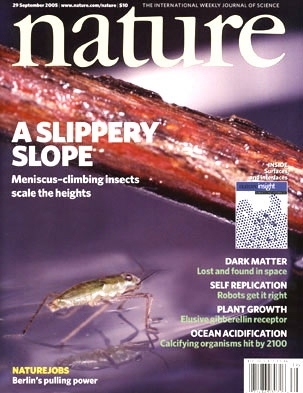
Research by MIT scientists and colleagues has graced the cover of Nature four times over the last month and a half.

On Sept. 29 the weekly, one of the world's premier science journals, featured work led by Professor John Bush of mathematics on how certain insects navigate the surface of water. The Oct. 6 cover focused on the origin of short gamma-ray bursts, violent cosmic events marking the collision of two compact stars. George Ricker, a senior research scientist at the MIT Kavli Institute for Astrophysics and Space Research, led the MIT team involved in that work.

On Oct. 20, the journal ran an image of Z-DNA, an unexpected left-handed form of DNA discovered by Alexander Rich, William Thompson Sedgwick Professor of Biophysics, and colleagues more than 20 years ago. Now Rich and his team have determined the crystal structure of the junction between Z-DNA and "normal," right-handed DNA (B-DNA).

The following week, Nature focused on the completion of the HapMap project, a comprehensive catalog of the genetic diversity in the human genome sequence across human populations. Several researchers from the Broad Institute of MIT and Harvard were co-authors of a paper on the work.

A version of this article appeared in MIT Tech Talk on November 16, 2005 (download PDF).
Related Links

Related Topics

More MIT News

Globular blue and white orbs "examining" single-stranded RNA products and marking them with green checks or red x's

Why are some bacterial genes high in purines?

In certain species of bacteria, the answer lies in shielding RNA transcripts from a quality-control factor called Rho. Understanding the requirements for expressible sequences is critical for expression engineering of therapeutic agents.

Read full story

Rich Nielsen, Volha Charnysh, Kevin Dorst, and Emily Richmond Pollock seated at a table, talking

Building a scholarly community

The SHASS Faculty Fellows Program, administered by the MIT Human Insight Collaborative, is fostering new research projects and creating space for supportive and interdisciplinary discussion.

Read full story