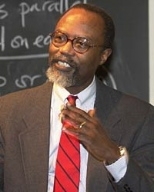
About 30 faculty, student and staff members attended the first of three open meetings scheduled by the Committee on Community to discuss the importance of freedom of expression on campus in the face of heightened world tension and the threat of war.
"People from nations, regions and even religions that are targets of anger and hate are likely to be very much a part of our own community," said Chancellor Phillip Clay, chair of the 22-member committee that includes faculty, students, administrators and staff. "We must be prepared to support all of our members throughout these times."
Clay introduced three members who spoke at the meeting Monday afternoon in Room 10-250: MIT Police Chief John DiFava; senior Jyoti Agarwal; and William Van C. Schalkwyk, director of environmental programs and risk management.
DiFava outlined the role that police play in ensuring individual safety, mobility and expression. Van Schalkwyk discussed ways in which emergency responses and security had been upgraded. Agarwal noted the range of resources available and the administration's eagerness to support student initiatives.
"The audience response was very positive," said Kirk D. Kolenbrander, special assistant to the president and the chancellor as well as a member of the committee, which has been meeting since November. "They seemed to be pleased that MIT would be that supportive."
The committee has adopted the following principles:
MIT is an educational institution first and foremost.
"MIT is an environment that encourages informed analysis and dialogue, the expression of multiple points of view, and the provision of educational forums and other opportunities for the exchange of information and diverse views on the world situation.
"Freedom of expression is essential to the mission of a university. So is freedom from unreasonable and disruptive offense. We should avoid putting these essential elements of our university to a balancing test, and consider both the interests of individuals and the community as well as the right to freedom of expression."
MIT is an international institution.
"The education MIT provides and the research MIT produces are dependent on bringing together the best minds from around the world, regardless of nationality, religion or political views. We will continue to operate as an international institution that, with significant collaborations around the world, is committed to producing global citizens."
All members of the MIT community are full members.
"While fulfilling our responsibility to abide by the law, we will work to protect the rights and opportunities of all students, faculty and staff to pursue their academic, professional and research interests. We will continue to work diligently to keep our campus a welcoming, safe and supportive place to live, work and study. We will support those members of our community who are called to national service."
Questions and comments should be addressed to community-questions@mit.edu. For more information, see http://web.mit.edu/community.
A version of this article appeared in MIT Tech Talk on February 26, 2003.