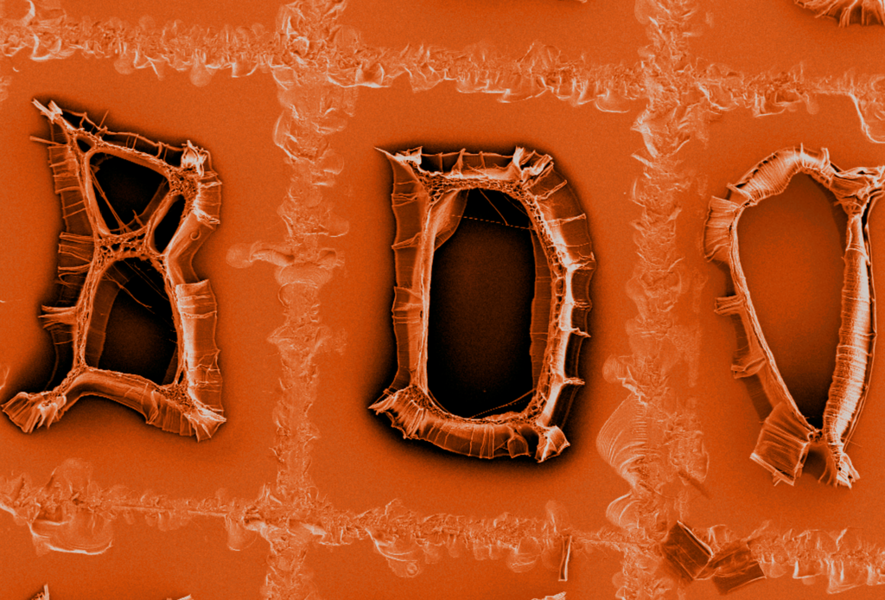
As part of her research on nanomaterials, PhD student Ashley Kaiser recently grew millions of carbon nanotubes — each incredibly strong and only 1/10,000 the width of a human hair — and immersed them in a guiding liquid. Upon drying, the resulting nanotube "forest" created a recognizable spooky pattern.
"The initial motivation behind this work was to densify carbon nanotube forests into predictable, cellular patterns by gently wetting them with a liquid, a process that can help enable scalable nanomaterial manufacturing," says Kaiser, who studies in the lab of Professor Brian Wardle. "The pattern was not precisely planned. While I knew that the carbon nanotubes would form cell-like shapes, I didn't know that these three particular sections would spell out 'Boo' so nicely, so it was a pretty special find."
The image was captured using a scanning electron microscope, which produces images in greyscale; the orange color was added later as a special effect. "It was exciting to find this under the microscope, and I thought that it would be great for Halloween the moment I saw it!" Kaiser says.
Submitted by: William Litant/Department of Aeronautics and Astronautics | Image by: Ashley Kaiser
Have a creative photo of campus life you'd like to share? Submit it to Scene at MIT.