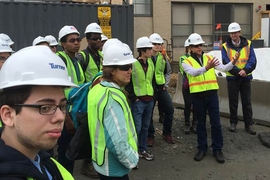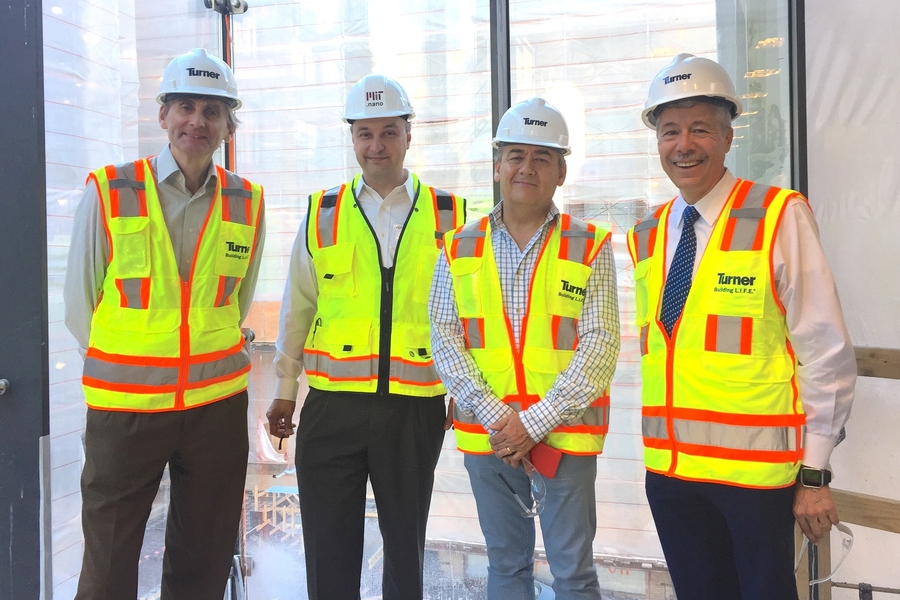
On Oct. 4, MIT.nano and the Microsystems Technology Laboratories (MTL) received a visit from José Antonio Fernández Carbajal, chair of the board of Instituto Tecnológico y de Estudios Superiores de Monterrey (ITESM), casually known as Monterrey Tec. Fernandez Carbajal was at MIT for his first meeting as the newest member of the MIT Corporation and reserved time to tour MIT.nano and get an update on its progress.
Monterrey Tec is a private, nonprofit, independent institution in Mexico known for its emphasis on social responsibility and entrepreneurship. It was founded in 1943 by Don Eugenio Garza Sada, who graduated from MIT with a bachelor's degree in civil engineering in 1914, just before the new Cambridge, Massachusetts campus opened.
In 2015, MIT and Monterrey Tec established a program, MIT-Tec, designed to support the Tec in its quest to become a world-class research university. Initiated by Vladimir Bulović, associate dean for innovation and director of MIT.nano, and led by MTL Director Jesús del Alamo, the program hosts research visits of Monterrey Tec’s students, postdocs, and faculty at MIT in the general areas of nanotechnology and nanoscience. To date, eight different research groups at MIT have already hosted extended stays for five Monterrey Tec students, seven postdocs, and four professors. Eight more are scheduled to arrive in the next few months. Their areas of research encompass microfluidics, nanostructures for biomedical applications, telecommunications, nanoscale 3-D printing, microelectromechanical systems (MEMS), and organ-on-a-chip.
The hands-on research underpins a robust and growing program of MIT-Tec educational exchanges. In May 2016, the "MIT Day at the Tec: Workshop on Sensors and Actuators" hosted 11 MIT and 12 Tec technical presentations at the Monterey Tec campus. Over the last three years at MIT, more than 70 Tec students, postdocs, and professors have attended the MTL nanoLab, a one-week hands-on course on nanotechnology.
Monterrey Tec is an esteemed partner of MIT.nano, which will open its new building in mid-2018. Visiting Monterrey Tec students, postdocs, and faculty will be conducting research in the new state-of-the-art facility, including the prototyping facility, which will be named in recognition and appreciation of Monterrey Tec and its valued partnership with MIT.