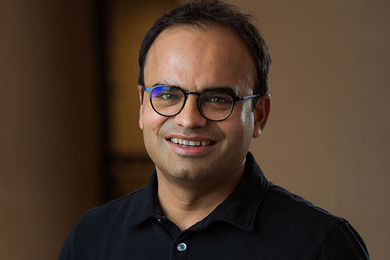
Helping AI models to meet the real world
Through research and entrepreneurship, Professor Devavrat Shah is helping to design methods that can handle constant decision-making using limited computational resources.
Through research and entrepreneurship, Professor Devavrat Shah is helping to design methods that can handle constant decision-making using limited computational resources.
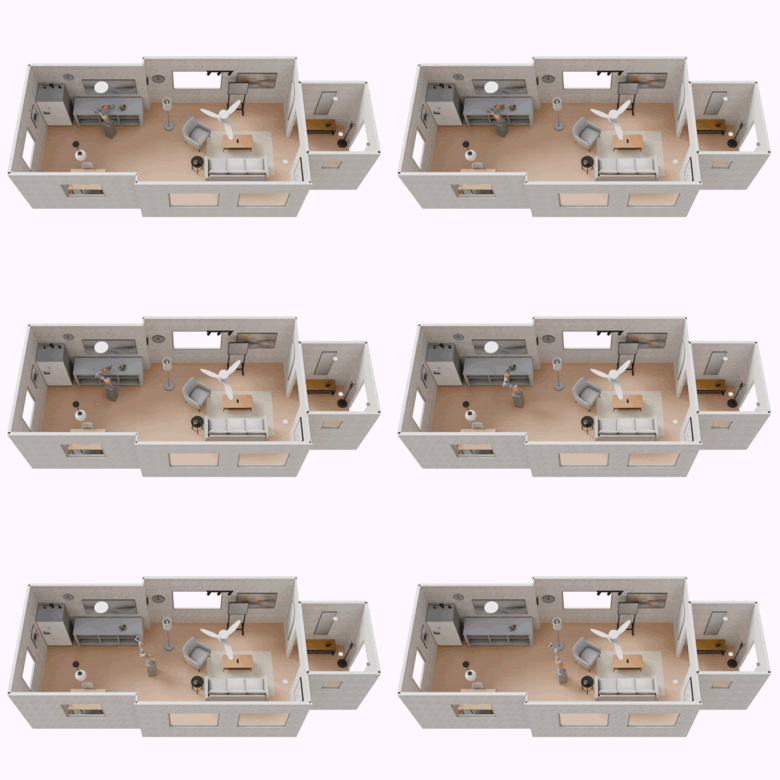
“SceneSmith” system uses collaborative AI agents to create realistic 3D environments of places like kitchens, hotels, and living rooms, where robots can simulate everyday chores.

Researchers developed an auditing technique to test generative AI models for malicious capabilities, without prompting them for illegal outputs.
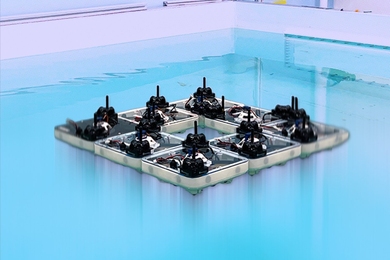
MIT researchers developed FloatForm, a swarm of small aquatic robots that snap together like ants forming a raft, assembling into reconfigurable structures on the water.

PhD candidate Henry Wang works with FIFA and other organizations to advance the way sports are played, analyzed, and refereed.
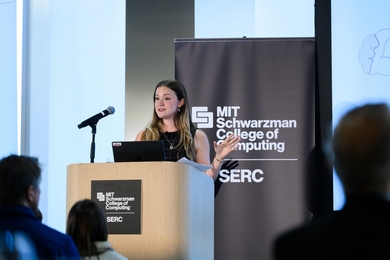
PhD student Rachel Sava, winner of the Envisioning the Future of Computing Prize, explores transformative improvements and dystopian risks of neural technology.

Computer scientist Phillip Isola cuts through the hype to explain how AI agents work and what the future might hold for this rapidly advancing technology.

Associate Professor Anna Huang delivers the keynote address, “In Search of Human-AI Resonance,” to a capacity crowd.

To help robots do chores in places like homes and factories, a new approach from MIT uses one language model to clarify users’ instructions, then another to ignore irrelevant info.
“Scientific American” showcases the history and future of America’s scientific engine, highlighting promising young scientists and icons at MIT and beyond.

Enjoy these recent titles from Institute faculty and staff.

A new system, known as Murakkab, optimizes the design and deployment of multistep workflows that power AI applications.
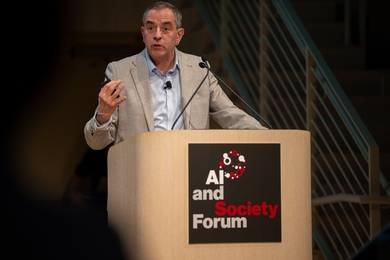
During the AI and Society Forum, leading MIT researchers examined critical questions about AI’s influence on employment and democracy.

Researchers combined an efficient algorithm with dedicated hardware to rapidly generate 3D maps for navigation using minimal memory and power.
Ranking at the top for the 15th year in a row, the Institute also places first in 12 subject areas.