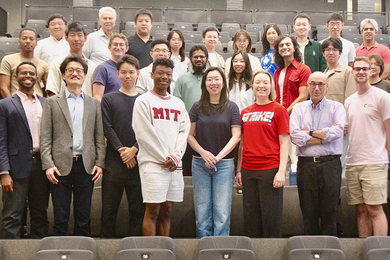
Dedric A. Carter has been named the new executive director of the School of Engineering's Engineering Outreach Programs (formerly Engineering Special Programs), effective April 1, 2006.
Carter will replace Karl Reid, who became director of the Office of Minority Education and assistant to the chancellor and associate dean for undergraduate education last fall.
Carter was a member of the MIT Corporation from 2000 to 2005 and currently serves on the visiting committees for the Engineering Systems Division and for music and theater arts. He is also a member of the board of directors of the MIT Club of Washington, D.C.
Carter, who holds an S.B. and M.Eng. (1999) in electrical engineering and computer science from MIT, has 10 years of experience in business and information technology, said Dean of the School of Engineering Thomas Magnanti, who announced the appointment in late January.
Carter participated in the 1993 MITES summer program, which is part of the Engineering Outreach Programs. The outreach programs also include the Saturday Engineering Enrichment and Discovery (SEED) Academy and Science Technology Engineering Math (STEM), a program for Boston middle school students.
"Dedric's experience in developing educational training programs, his deep understanding of the issues, and his passion for improving K-12 education in the U.S. will be critical as we grow and improve our outreach activities," Magnanti said.
Magnanti also thanked Reid for his work in the outreach programs. "We are grateful that Karl plans to maintain a strong connection to the school and our students, advising, motivating and inspiring us all," he said.
A version of this article appeared in MIT Tech Talk on February 8, 2006 (download PDF).