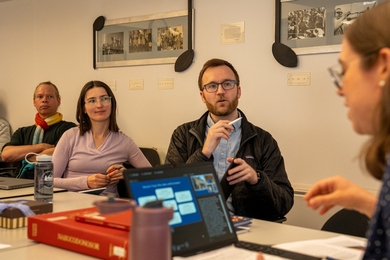
More than 80 MIT students will spend their spring break volunteering their services instead of sunbathing on the beach of a tropical island. They're participating in Alternative Spring Break, a student-managed program that sends volunteers out to teach, build homes, assist at children's camps and work in AIDS hospices.
MIT's Alternative Spring Break (ASB) was started in 1996 by Anthony Ives, then an MIT junior, who arranged for a few students to teach in the inner-city schools of Washington, DC. The ASB is now run by five student officers who have expanded the program to serve eight communities in the United States and Puerto Rico.
This year's trips, scheduled for March 20 to 27, are:
- The AIDS Awareness Trip to New Orleans will place volunteers in Project Lazarus, an AIDS hospice, where they will "help people there live their daily lives," said ASB publicity chair Cherry Liu. Other volunteers will be placed at Belle Reve, where they'll provide services like painting and cleaning.
- ������Students going to Camp Speers, a YMCA Environmental Education camp for children in Dingmans Ferry, PA, will teach ropes courses, team work, survival, ecology, cross-country skiing, rock climbing, hiking, ice fishing, archery, arts and crafts, and ice skating.
- ������The three Habitat for Humanity teams in Philadelphia, PA, Richmond, VA and Washington, DC will pound nails, paint, frame, dry-wall, roof, apply siding, and take on other construction work to help build houses.
- Two teams will travel to Washington, DC, and Baltimore, MD, in partnership with Teach for America, a program that gives recent college graduates the opportunity to teach in inner-city or rural schools. ASB members will work with Teach for America teachers with lesson plan and curriculum design.
- Ten students will teach in the inner-city schools of San Juan and in the rural areas of Culebra near San Juan. The ASB participants will use Spanish in the classroom.