Skip to content ↓

"Shark Tank" meets book publishing

The MIT Press will host a Pitchfest competition at this year's Boston Book Festival.

Press Contact:

Kate Silverman Wilson
Phone: (617) 258-0564
MIT Press
Close
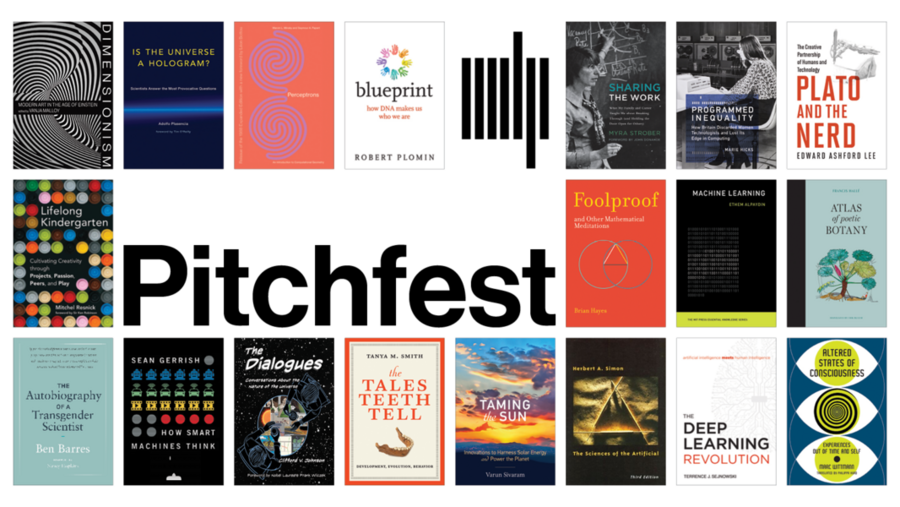
Pitchfest will give six contestants the opportunity to present their best science or technology book idea before a panel of judges and a live audience at the Boston Book Festival in October.
Caption:
Pitchfest will give six contestants the opportunity to present their best science or technology book idea before a panel of judges and a live audience at the Boston Book Festival in October.
Credits:
Image courtesy of MIT Press

Do you have a great idea for a nonfiction book in science or technology, broadly defined? Editors receive hundreds of inquires each year. But what makes one book project stand out from the rest?

In the spirit of fun and fostering the Boston publishing scene, the MIT Press is hosting its first-ever Pitchfest competition.

Pitchfest will give six contestants the opportunity to present their best science or technology book idea before a panel of judges and a live audience at the Boston Book Festival on Oct. 13 in Boston. The winner will be given the opportunity to workshop a full-fledged book proposal with an MIT Press editor, get advice on how to navigate the publishing world, and receive a $1,000 cash prize.

The deadline for submissions is Sept. 1, after which time finalists will be selected and given offers to participate in the event. Pitchfest is an open competition and anyone is welcome to submit a proposal.

The MIT Press is a leading publisher of books and journals at the intersection of science, technology, and the arts. MIT Press books and journals are known for their intellectual daring, scholarly standards, and distinctive design.

Related Links

Related Topics

Related Articles

More MIT News

Rich Nielsen, Volha Charnysh, Kevin Dorst, and Emily Richmond Pollock seated at a table, talking

Building a scholarly community

The SHASS Faculty Fellows Program, administered by the MIT Human Insight Collaborative, is fostering new research projects and creating space for supportive and interdisciplinary discussion.

Read full story

Globular blue and white orbs "examining" single-stranded RNA products and marking them with green checks or red x's

Why are some bacterial genes high in purines?

In certain species of bacteria, the answer lies in shielding RNA transcripts from a quality-control factor called Rho. Understanding the requirements for expressible sequences is critical for expression engineering of therapeutic agents.

Read full story