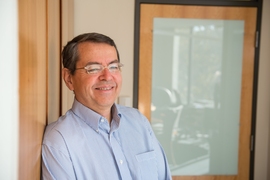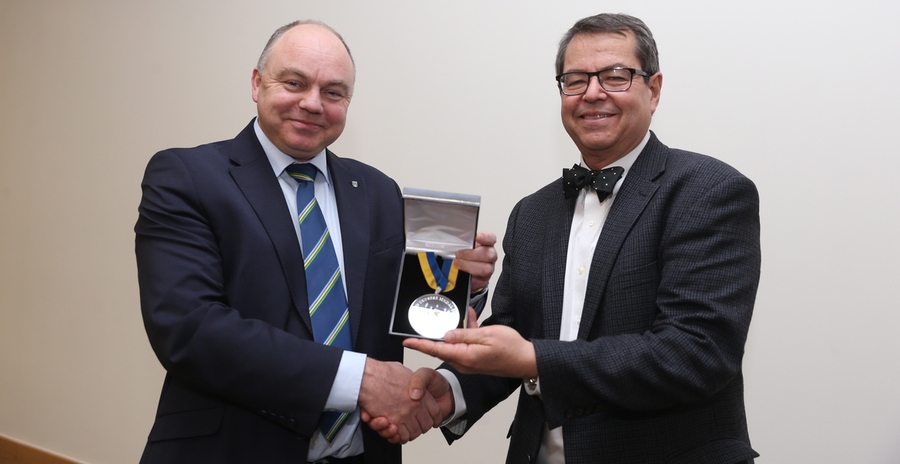
Stephen L. Buchwald, the Camille Dreyfus Professor of Chemistry, has been awarded the UCD Ulysses Medal, the highest honor that University College Dublin can bestow. The award recognizes his outstanding global contribution to the field of chemistry.
Inaugurated in 2005, the UCD Ulysses Medal is named in honor of University College Dublin’s most famous alumnus, James Joyce, who is widely regarded as the father of the modern novel and the most seminal author of the 20th century. Buchwald is the third MIT faculty member to win the Ulysses Medal, following Professor Noam Chomsky and Institute Professor Phillip Sharp.
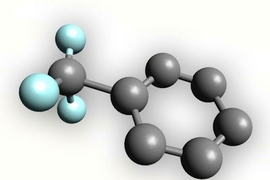
"[Buchwald’s] catalytic methods for the formation of C-C, C-N, and C-F bonds and the selective transformations of small molecules, as exemplified in his excellent presentation this afternoon, have a major impact on synthetic chemistry with enormous applications in medicine and in industry,” said Professor Andrew J. Deeks, president of UCD who presented the award.
“He is a pioneer of ‘aryl amination,’ a significant C-N bond-forming reaction using palladium catalysts, and this reaction is named after him and Professor Hartwig, who simultaneously reported their research in this field. He is one of the top-cited organic chemists in the world, indeed one if the most influential. It is therefore a great honor to present the UCD Ulysses Medal to Professor Steve Buchwald,” he said.
To learn more, visit the UCD website.