Skip to content ↓

Introducing the Center for Advanced Urbanism

Creating new models for 21st century cities
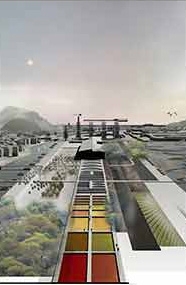
The Estuarine Power Machine is an engineered landscape nested within the Nervion River Valley. Resembling a public park with a new, dense urban edge, the machine uses its intertidal position in the river to perform all of the region's massive hydrological infrastructure needs.
Caption:
The Estuarine Power Machine is an engineered landscape nested within the Nervion River Valley. Resembling a public park with a new, dense urban edge, the machine uses its intertidal position in the river to perform all of the region's massive hydrological infrastructure needs.
Credits:
Image: Matt Bindner and Daniel Daou

This spring, the School of Architecture and Planning (SA+P) is launching a major new research center focused on the planning, design, construction and retrofitting of urban environments for the 21st century.

Under the leadership of center director Alexander D’Hooghe and research director Alan Berger — professors of architecture and of urban design and landscape architecture, respectively — the Center for Advanced Urbanism will coordinate collaborations among existing efforts in SA+P and with other MIT groups, as well as undertaking new projects at the Institute and with sponsors in practice.

Read more
Related Links

Related Topics

More MIT News

Globular blue and white orbs "examining" single-stranded RNA products and marking them with green checks or red x's

Why are some bacterial genes high in purines?

In certain species of bacteria, the answer lies in shielding RNA transcripts from a quality-control factor called Rho. Understanding the requirements for expressible sequences is critical for expression engineering of therapeutic agents.

Read full story

Rich Nielsen, Volha Charnysh, Kevin Dorst, and Emily Richmond Pollock seated at a table, talking

Building a scholarly community

The SHASS Faculty Fellows Program, administered by the MIT Human Insight Collaborative, is fostering new research projects and creating space for supportive and interdisciplinary discussion.

Read full story