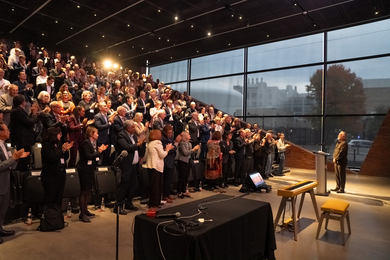
On June 20, MIT’s newly formed Employee Resource Groups (ERGs) presented a career development discussion panel in which staff shared their experiences, insights and recommendations on developing a career at MIT. The program is part of the mission of the ERGs to create a positive and inclusive work environment that supports and retains employees.
Ed Bertschinger, newly appointed Institute Community and Equity Officer (ICEO), kicked off the session, which featured the participation of staff from across the Institute, including: Michelle Coleman, administrative officer, Department of Biology; Mary Grenham, administrative officer, Linguistics and Philosophy; Ken Hewitt, assistant director, Human Resources and Facilities Lab for Nuclear Science; and Eileen Ng, assistant dean, Finance and Human Resources in the School of Engineering.
Coleman recounted that after many years as a senior-level administrator in biology at Columbia, NYU and Harvard, coming to MIT was a surprising new experience. “I thought that at this point in my career, I was a subject matter expert, but I quickly found that there were people here who had been in the field and at MIT far longer than I had. I no longer knew all the answers so I had to take a different approach and give myself the time to learn and listen.”
“Building a peer network is so important to getting to know MIT," Coleman advised. "After almost three years, I feel I’m just starting to know my way around the campus and The Institute,” she laughed. “MIT used to feel like a vast city to me, now it seems like a small village.”
Participants also learned about the importance of being the best at what they do — adding value; being prepared; building relationships and networking; setting high goals; and taking advantage of MIT’s tuition assistance program and Informational Interview network group on Yammer.
Ed Bertschinger, newly appointed Institute Community and Equity Officer (ICEO), kicked off the session, which featured the participation of staff from across the Institute, including: Michelle Coleman, administrative officer, Department of Biology; Mary Grenham, administrative officer, Linguistics and Philosophy; Ken Hewitt, assistant director, Human Resources and Facilities Lab for Nuclear Science; and Eileen Ng, assistant dean, Finance and Human Resources in the School of Engineering.
Coleman recounted that after many years as a senior-level administrator in biology at Columbia, NYU and Harvard, coming to MIT was a surprising new experience. “I thought that at this point in my career, I was a subject matter expert, but I quickly found that there were people here who had been in the field and at MIT far longer than I had. I no longer knew all the answers so I had to take a different approach and give myself the time to learn and listen.”
“Building a peer network is so important to getting to know MIT," Coleman advised. "After almost three years, I feel I’m just starting to know my way around the campus and The Institute,” she laughed. “MIT used to feel like a vast city to me, now it seems like a small village.”
Participants also learned about the importance of being the best at what they do — adding value; being prepared; building relationships and networking; setting high goals; and taking advantage of MIT’s tuition assistance program and Informational Interview network group on Yammer.