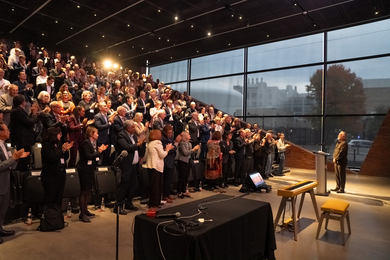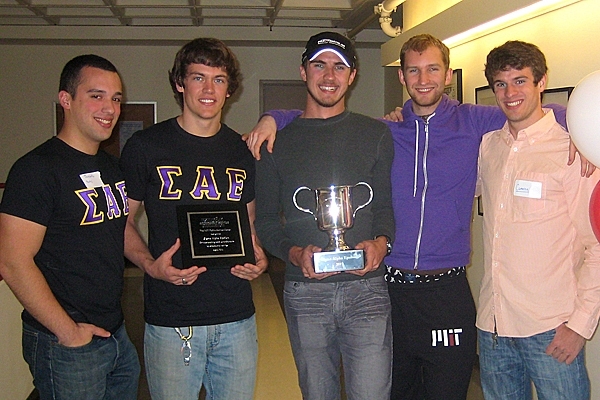
The brothers of Sigma Alpha Epsilon fraternity (SAE) took home the inaugural 2011 Service Cup on Wednesday, April 20, at a ceremony to honor all participants in the inaugural FSILG&D Community Service Challenge.
Organized by the MIT Public Service Center (PSC), the competition asked fraternities, sororities, independent living groups, and dorms to serve the community as a community. Fourteen teams took up that challenge and teamed up within their Greek or residential communities to make an impact.
SAE partnered with local community organizations Habitat for Humanity, the Museum of Science and Big Brothers/Big Sisters. The competitions judges singled out SAE for demonstrating strong community interaction, initiative, goal setting, leadership, reflection and group collaboration to create a winning service culture in their fraternity. And along the way, the brothers said, they increased their brotherly bond by serving and learning about the community.
"The MIT Public Service Center is proud of the community service accomplishments of all 14 participating fraternity, sorority and dorm teams," said Sally Susnowitz, PSC director. "We thank all the team leaders for organizing their teams and motivating their fellow students to engage in service."
Organized by the MIT Public Service Center (PSC), the competition asked fraternities, sororities, independent living groups, and dorms to serve the community as a community. Fourteen teams took up that challenge and teamed up within their Greek or residential communities to make an impact.
SAE partnered with local community organizations Habitat for Humanity, the Museum of Science and Big Brothers/Big Sisters. The competitions judges singled out SAE for demonstrating strong community interaction, initiative, goal setting, leadership, reflection and group collaboration to create a winning service culture in their fraternity. And along the way, the brothers said, they increased their brotherly bond by serving and learning about the community.
"The MIT Public Service Center is proud of the community service accomplishments of all 14 participating fraternity, sorority and dorm teams," said Sally Susnowitz, PSC director. "We thank all the team leaders for organizing their teams and motivating their fellow students to engage in service."