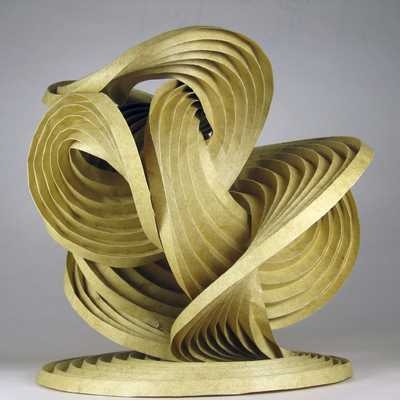
The artwork of Erik Demaine, an associate professor in the Department of Electrical Engineering and Computer Science (EECS), has been selected as part of the Smithsonian’s 40 Under 40: Craft Futures exhibition, which will run July 20, 2012, through Feb. 3, 2013. Demaine's work was created in in collaboration with Visiting Scientist Martin Demaine, of the Computer Science and Artificial Intelligence Laboratory (CSAIL).
The show will feature 40 artists, all born since 1972, and is being held in honor of the 40th anniversary of the Renwick Gallery, the Smithsonian’s branch museum that plays host to its decorative arts and contemporary craft programs. As part of the 40 Under 40 exhibit, the Smithsonian also plans to place works by each artist in the museum’s permanent collection.
Demaine — a MacArthur Fellow, Alfred P. Sloan Research Fellow and member of the Theory of Computation Group and The Algorithms Group at CSAIL — called the selection “quite an honor.” His artistic interests include origami and glassblowing. Several of his curved origami sculptures are housed in the permanent collection at the Museum of Modern Art in New York. Martin Demaine, Erik's father, is the Angelika and Barton Weller Artist-in-Residence at EECS.
For more information on the exhibit, visit http://americanart.si.edu/exhibitions/archive/2012/renwick40/, and for more on the Demaines' artwork, visit http://erikdemaine.org/.
The show will feature 40 artists, all born since 1972, and is being held in honor of the 40th anniversary of the Renwick Gallery, the Smithsonian’s branch museum that plays host to its decorative arts and contemporary craft programs. As part of the 40 Under 40 exhibit, the Smithsonian also plans to place works by each artist in the museum’s permanent collection.
Demaine — a MacArthur Fellow, Alfred P. Sloan Research Fellow and member of the Theory of Computation Group and The Algorithms Group at CSAIL — called the selection “quite an honor.” His artistic interests include origami and glassblowing. Several of his curved origami sculptures are housed in the permanent collection at the Museum of Modern Art in New York. Martin Demaine, Erik's father, is the Angelika and Barton Weller Artist-in-Residence at EECS.
For more information on the exhibit, visit http://americanart.si.edu/exhibitions/archive/2012/renwick40/, and for more on the Demaines' artwork, visit http://erikdemaine.org/.