This is the fourth in a series of articles from the Office of the Dean for Undergraduate Education (DUE) that answers the questions: What does that office really do? Who works there? And how does the office advance/impact education at MIT?
What exactly is the Edgerton Center?
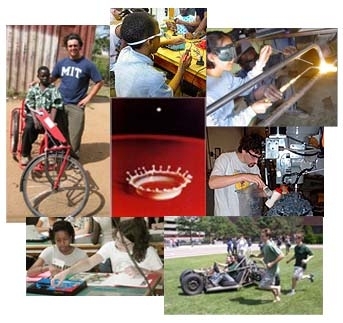
If you look at the long list of programs, classes and initiatives that are part of the Edgerton Center, it seems like an unlikely collection. How does a class in high-speed imaging, a machine shop, classes on international development, and K-12 outreach fit together? The answer is quite simple: The unifying element is hands-on learning.
Since it was opened in the early 1990s, the Edgerton Center has been based along Strobe Alley on the fourth floor of Building 4. This is where Professor “Doc” Edgerton conducted his pioneering work in strobe photography. It is also where he inspired and encouraged many students to translate theory into practice and learn by doing. In perpetuating Doc Edgerton’s legacy, mens et manus (mind and hand) is embodied in every aspect of the Edgerton Center.
What is 'hands-on learning' at the Edgerton Center?
What exactly is the Edgerton Center?
If you look at the long list of programs, classes and initiatives that are part of the Edgerton Center, it seems like an unlikely collection. How does a class in high-speed imaging, a machine shop, classes on international development, and K-12 outreach fit together? The answer is quite simple: The unifying element is hands-on learning.
Since it was opened in the early 1990s, the Edgerton Center has been based along Strobe Alley on the fourth floor of Building 4. This is where Professor “Doc” Edgerton conducted his pioneering work in strobe photography. It is also where he inspired and encouraged many students to translate theory into practice and learn by doing. In perpetuating Doc Edgerton’s legacy, mens et manus (mind and hand) is embodied in every aspect of the Edgerton Center.
What is 'hands-on learning' at the Edgerton Center?
- Courses for MIT students — directly involving students in learning
- D-Lab — experiential learning focused on international development
- International Development Initiative (IDI) — encouraging students to make a difference
- Clubs and teams — learning outside the classroom
- Student Machine Shop — lathes, saws and presses, oh my!
- K-12 Educational Outreach — getting kids excited about math and science